Guest Post: Top 3 Bug Out Bag Items Most People Forget About

Top 3 Bug Out Bag Items Most People Forget About

When you hear the term, “bug out bag,” most people think of a whole laundry list of items that they believe must be in their bug out bags.

Here are the most common things people add to their bug out bags:

  • Weapons (guns, ammunition, knives, etc)
  • Ammunition
  • Food
  • Water cleaning equipment
  • First aid solutions
  • Shelter equipment
  • Paracord
  • Fire starting equipment

These are all very necessary when it comes to a bug out bag, but I think we’re missing a few key ingredients to a well mannered survival kit.  I’ve been the owner of www.SurvivalBlog.org for the last 5 years, and I believe that every bug out bag needs to contain these three items in addition to the normal survival gear.

Forgotten Bug Out Bag Necessity #1: A Meat Thermometer

I’m an avid hunter and constantly am using my meat thermometer for everything from chicken to wild hog – I never would leave home without one.

In a grid-down, survival situation, you’ll be needing to use this meat thermometer way more often than you would in the comfort of your own home.

Remember: just about all meat can be eaten once it reaches about 165 degrees, but here’s some more information on meat:

  • Fish – 145 degrees
  • Poultry – 165 degrees
  • Ground meat – 165 degrees

Forgotten Bug Out Bag Necessity #2: Remington Oil

Remington Oil (Rem Oil) is a huge necessity in the field – and lots of it.  Not only can you clean your firearms, but you can also maintain your other survival tools.

Remington Oil protects guns, knives, forks, spoons – or any other metal device.

Forgotten Bug Out Bag Necessity #3: Bring Your Papers

During a SHTF situation, you won’t know if there will still be records around.

You might need to prove you own your own property, are married, or anything else.

It’s important to have copies of birth certificates, wedding certificates, tax receipts, land deeds, insurance documents, and other papers during a survival situation. When law and order is re-established, you might need to prove your very existence.


Your Thoughts?

If you thought this post was helpful, please Like, +1, or Share it using the social media buttons at the top of the page!  Can you think of any survival items that are often overlooked?  Please let us know in the Comments Section below, thanks!


Author Bio:

Andy Hallinan is an avid survivalist and owner of the second most trafficked survival blog in North America. Check out more of his stuff at www.survivalblog.org

Read More

EDC List

Every Day Carry List – Assessing Threats and Choosing Your EDC Items

EDC ListHopefully, by now, you’ve devised your bug out plan and have packed your bug out bag using our bug out bag list.

Awesome, you are now better prepared than the overwhelming majority of the populace. But what survival tools should you have in your every day carry kit?

Here we will look at what a survival minded person could have on their every day carry list that would help prepare them to deal with dynamic situations that may arise in everyday life.

What is an Every Day Carry List?

An every day carry list is a set of items that you have with you under most scenarios (at all times if possible) that helps you be prepared at a moment’s notice to deal both daily situations as well as be ready to survive in emergency situations. These items may be designed to aid your survival on their own, or they may be there to help you get to a safe location or back home. It can be made up of a wide variety of items and should be tailored to your lifestyle, locality, and probable threats.

Ideally, the items on an every day carry list will be small both in number and size and will be possible to carry on your person without an extra bag or container to lug around. There are some people however that do choose to carry the items on their every day carry list in a specific EDC bag and others who prefer to consolidate this kit into fewer, more flexible items such as those covered in our 10 Best Multi-Purpose Survival Tools post.

What should be on YOUR Every Day Carry List?

1. Things You Carry With You Already

This is important to review for a couple of reasons. Firstly, they probably reveal some of your basic day-to-day needs which give us insight into what your greater every day carry (EDC) needs may be. Secondly, if you are already carrying an item with you, you would not need to replicate its uses or functions elsewhere. Or perhaps you can modify one of these items to make it a better EDC tool without adding another piece into your EDC kit. Keeping an every day carry list simple and light is key.

  • Wallet – I need my ID and cash daily. I can’t leave home without this.
  • Keys – Can’t leave home without these unless I want to climb through the window to get back in! I am going to add a “Grenade” Survival Kit Key Fob to my keyring, which comes with more paracord and a fire starting kit.
  • Phone – I always have my phone on me to contact loved ones or the authorities in the event of an emergency. To improve this, I am going to load PDFs onto it with critical documents and a map of my local area in case I need to access these while the phone network is unavailable. I am also going to slip a razor blade and a laminated hard copy of that same map in the space between the case and the back of the phone as backups. If you do this, don’t forget to remove the blade before going through a security checkpoint at an airport!
  • Watch – A friend once told me “Never trust someone who doesn’t have a watch.” It is an item that many of us carry every day. Some ways we can supercharge this into an EDC survival tool is to add a compass or use a paracord woven watch band. If you do not want to add a compass, you can learn to use your watch as a navigation tool.

2. Things That Would Help With Frequently Encountered Problems

Do you have problems that you face repeatedly? Is there a potential problem that has a high probability of occurring in your normal day or commute? Is there something that you frequently use that has the potential to break? Having an EDC item that could assist in these situations would make your life easier generally and be of great help when the high potential risks become a reality.

  • Folding Knife – I have to frequently cut cardboard and plastic at work, but this would also be good if I was in a more office based role where I would be dealing with staples or opening letters. You cannot go wrong with the Kershaw Blur Folding Knife with a Partial Serrated Blade that I have been carrying with me for years and it still is razor sharp and can be easily opened with one hand. A small yet powerful addition to an every day carry list. Check out our in-depth article on How To Pick The Best EDC Knife.
  • Flashlight – I am in a dark parking lot daily that this will help out with that. It will also be useful in case of a blackout or a fire. A good LED flashlight (check out our article here on picking the best EDC flashlight) is also powerful enough to signal for help and small enough to fit in a pocket and can also double as a self-defense tool. We love the Fenix PD35.
  • Multitool – A multitool is the jack-of-all-trades of the tools that you can carry with you every day. You can get a full-fledged multitool such as the Leatherman Skeletool or opt for a lower profile tool that has less functionality by carrying a credit card multitool that fits in your wallet.

3. Things That Would Help With Rare and High Consequence Problems

This is a category of items that needs to be risk assessed versus threats in your area. They are meant to cover potential problems that are low probability to occur but if they did, would have a severe consequence. We will go over performing a risk assessment below, but a brief example would be if you ride in a vehicle to work every day. For this activity, there is a very low probability of needing to escape the train, bus, or car but if there was a crash and you needed to exit quickly, there would be severe consequences of not being able to do so. In this case having a glass breaking Tactical Pen or a seatbelt cutter would make a huge difference towards improving your chances of survival. Tools of this nature are what make up this category.

  • Tactical Pen – A Tactical Pen is a high-grade metal pen that can double as a self-defense tool and glass breaking aid. I constantly need a pen at work so carrying this with me will not be adding an unnecessary item that I will rarely use. This is more of an upgrade to meet a daily need with the capability to address the rare but high consequence situation of defending yourself in the event of a personal attack. The Gerber Impromptu is an excellent choice for this although we cover several great options in our Tactical Pen buying guide.
  • Pry tool – This will help me open doors and containers in the event of a car accident or a problem in my workplace or home. There are many options out there for this, the best one I found is the Boker Minibar Blade which excels in function, having both a pry tip and lever tool, but is a bit rough on the wallet. A cheaper option would be the Key Chain Pry Tool by Schrade.
  • Paracord – Paracord is awesome as it is light, strong, and will not rot. It has nearly as many uses as duct tape. I would not be looking to carry around enough to make a rope ladder or anything as complicated as that but having some at my disposal if I need to splint a broken bone or tie an emergency shelter down would be handy. There are a lot of options for paracord bracelets and other wearable items, such as The Friendly Swede Paracord Bracelet as it comes with a metal clasp that doubles as an emergency fire starter.

Our Favorite Every Day Carry Gear

For some more ideas, be sure to check our 10 Best Multi Purpose Survival Tools post for some other versatile EDC items.

How To Assess Risk

Rating the relative risks of threats in your locality is a good way to judge whether an item is worth including in you every day carry list or even your bug out bag contents.

The basic process for this is to judge each threat on two criteria:

  1. Probability – What are the chances of the threat occurring? Is it something that is highly probable (like slipping and falling on ice), which you see once a week or several times per month? Is it low probability (like an earthquake), which you would expect to see maybe once per year or every several years? Is it somewhere in between such as a car accident? Rate the probability of threats occurring realistically from your own experience and what has occurred historically in your locality.
  2. Potential Impact – What would the impact be if the threat actually happened? Would it be mild and easy to overcome? Would it send people to the hospital? Does it have the potential to be deadly?

We have created this Threat Assessment Matrix to help you visualize this concept:

Every Day Carry list Threat Assessment Matrix

This chart is a great tool for determining whether or not to add an item to your every day carry list. Keep it in mind and refer to it when building yours.

Conclusion

As you can see, there are some easy steps you can take to assess your every day carry needs and determine what is appropriate to be put on your every day carry list. Stick to the principles of addressing realistic, probable threats and keeping your items multi purpose and small to be most effective.

Remember when planning your every day carry list, chance favors the well prepared.

If you still haven’t packed your bug out bag, make sure to review our Bug Out Bag List to help you get started ASAP. Your EDC kit and your BOB are key to being prepared for anything and everything!

Want Even MORE Info On Building Your EDC Kit?

If you are looking for even more information on how to build your ultimate EDC kit you can check out my book, The Every Day Carry Guide. It is a comprehensive manual that will teach you:

  • How to be prepared at all times – no matter where you are
  • How to build your first EDC kit from scratch
  • How to refine an existing kit to make it more effective
  • How to pick the best gear to realistically make you more prepared
  • How to assess threats and risks in your every day life

EDC-Book-w-Button

Your Thoughts

If you thought this post was helpful, please Like, +1, or Share it using the social media buttons at the top of the page! Do you have some every day carry items that you would like to share? Do you have any questions about making an every day carry list? Please let us know in the Comments Section below, thanks!

Read More

basic survival skills

5 Basic Survival Skills You Need When Bugging Out

As we mentioned in our How to Make a Bug Out Plan post, the more skills you have, the more self reliant you are and the higher your chances for survival become.  Here we are going to discuss some basic survival skills and teach you how to best utilize them to protect yourself and your loved ones when disaster strikes.

basic survival skills

Basic Survival Skills

When you are out on your own without the support net of a healthy society, these are the traits and basic survival skills you need to master in order to succeed.

1.  Positive Mental Attitude

This is actually more important than any of the other basic survival skills because when you are relying on your ability to wring survival from your surroundings, once you give up hope you are done.  There are many amazing stories of people who have survived avalanches, fires, floods, and being isolated for extended periods and making it through thanks to an undying will to survive.  They are ordinary people who would simply not quit.  Keeping a positive mental attitude will give you the strength to never give up on yourself no matter the circumstances.

Some ways to instill this mentality are:

  • Set goals for yourself – These may be daily or even hourly goals such as making it to the next hilltop or obtaining a meal from your surroundings.  Make sure they are achievable and objective based.  Every goal you accomplish will be a psychological boost for you and will build confidence in your basic survival skills.
  • Focus on what you can change – If a major disaster has struck, focusing on the unfairness of the resulting situation or the loss that has occurred will not help you.  However, focusing on building a shelter or staying dry will help immensely.  Concentrating your efforts to make your situation better will help you both in the long and short term.  Ignore the big picture and focus on improving your immediate situation.
  • Keep hydrated and nourished – This will give you the energy to persevere in the face of adversity.  A steady water and food supply are extremely important.  You will not be looking to feast daily but meeting your basic calorie and hydration needs will be enough to keep you going.  2400-3600 Calories  per day is a good amount to aim for.  Additionally, if this requirement is squared away it will allow you to focus more on recovery efforts or finding help.
  • Be outwardly positive – Positivity creates more positivity.  Showing fellow survivors that you are with that you have a positive mental attitude will prevent the group being dragged down under the weight of the disaster.  Be the seed that grows into higher morale for your team.

2.  Water

Beyond your own internal fortitude, water is the most important resource you require.  Finding it and knowing how to make it fit for consumption are two of of the most important basic survival skills you can learn.

  • Know how to look for signs of water.  This may be looking where plants are growing, where terrain slopes or contours into a natural water trap, or observing animal movements to see where they are finding their water supply.
  • If you are able to map a route as a part of your Bug Out Plan, identifying likely sources for water along the way will be a massive boon.
  • Understand how to treat water to make it fit for consumption.  Drinking contaminated water can be deadly.
  • Filtration – this consists of passing water through very fine membranes to remove particles and some pathogens.  Some viruses may still make it through even the finest filters available.
  • Purification – treating water with either chemicals such as iodine or UV light sources.  This neutralizes all pathogens but does not eliminate particles.
  • Boiling – This is a type of purification as it kills all pathogens but does not remove particles.  Water should be kept at a rolling boil for at least 1 minute to sterilize it.
  • Because of the separate benefits of both filtration and purification it is recommended that you use both methods to be 100% sure of water safety.  The most basic way to do this is to pour water through a cloth and then boil it.  However a more effective approach is to pass it through a filter device such as the MSR MiniWorks EX Microfilter and then purify it using tablets or a SteriPen.  These items should be considered mandatory requirements for any list of Bug Out Bag Essentials.
  • Be able to exploit rainfall if possible.  This may include catching it in a poncho or container if available.
  • Utilize a Solar Still – This can be purchased here or fashioned out of your survival gear.  A Solar Still uses the sun’s heat to evaporate liquid and then recapture it as clean water.
  • Understand how much water you need – A person can survive 72 hours without water.  It is however recommended that someone who is active consumes 75% of their weight in ounces daily. So if you weigh 150 lbs then you should be drinking about 113 ounces (3.31 liters) of water per day.
Basic Survival Skills
A Home Made Solar Still

3.  Food

  • Hiking with your Bug Out Bag loaded with essential survival gear will cause you to burn 400-500 calories in an hour.  To keep your body working as an efficient machine it is important to keep it fueled up.
  • First off, ration what food you have with you.  You are concentrating on survival, not feasting.  Eat small portions when you are hungry but do not over do it.
  • Supplement your rations with foraged sustenance from your surroundings.  This means you will need to learn what edible plants are around and how to harvest them.  Also learn where these plants grow.  Does a particular berry grow around water holes?  Does a high calorie plant prefer the shade?  Learn these aspects to understand where to look for sustenance.  Some plants are only edible after cooking or boiling, learn what you need to do with your local flora to make it palatable.  Additionally, learn what is hazardous or poisonous to eat to avoid making yourself sick!
  • Understand what types of animals inhabit your area.  This includes possible predators to avoid and prey to seek out.  Learn what environments these animals inhabit.  Is there a particular fish that likes eddies and whirlpools?  Target these spots to find them.  Does an animal in your area like to eat a particular plant?  Placing snares in the vicinity of these plants would be ideal.  If you do not know how to operate a firearm, a slingshot may be a good option for you.  There are many options for slingshots, such as The Scout Hunting Slingshot or learn how to make one here.  Also learn how to prepare these animals for cooking.  This includes skinning and butchering animals and filleting fish.  We have embedded the below videos as a tutorial in these basic survival skills.

Basic Survival Skills: How to Fillet a Fish

Basic Survival Skills: How to skin a squirrel

Basic Survival Skills: How to Butcher a Deer


4.  Shelter

A well prepared person will have a means of sheltering themselves from the elements as a part of their Bug Out Contents List.  However, a TOTALLY prepared person will also have learned survival shelter building as one of their basic survival skills.  A survival shelter does not need to be complicated or fancy but it should keep rain/snow out, keep heat inside, and be easily cobbled together from local materials.

  • A survival shelter can be built from most anything – debris from collapsed buildings, trees and leaves, animal hides, or a tarp or poncho
  • Consider bringing paracord and a saw or hatchet when building your Bug Out Bag Contents List as these can be your best friends when building a shelter.  With these items you can make a survival shelter out of just about anything in very little time.
  • If you do not have paracord, zip ties, duct tape, or another binding material, primitive rope can be improvised from strips of tree bark, small green saplings or branches, and vines.
  • A basic survival shelter could consist of building a frame from long rigid materials such as tree branches or 2×4’s and laying a poncho or tarp over it.
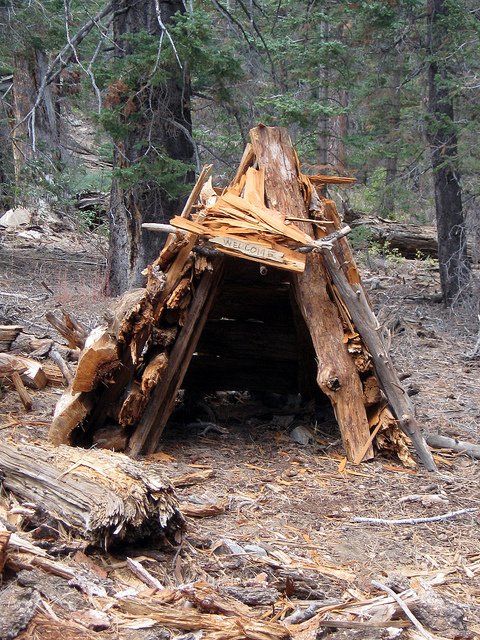
  • If you cannot use your poncho or tarp for this, layer brush on to the frame sloping away towards the ground to insulate for warmth and keep moisture out.   See the picture below for a general idea of this.
Store Bought Survival SheltersA Shelter Made On the Trail


Basic Survival Skills
Image Credit: simonov on Flickr

5.  Fire

Fire can provide many things when in a survival situation and both building and maintaining one are essential basic survival skills.  A fire will give a morale boost, provide heat and light, and enable you to purify water and cook food.
Everstryke Banner

  • The basic requirements to build any fire are to give it air, fuel, and an ignition source.
  • Air – A fire consumes air hungrily and it is important to build it in a way that allows air to flow into the combustion.  Do not smother a fire by putting too much fuel onto it.
  • Fuel – This is what actually burns in a fire and can be sourced from many places.  If a branch or stick snaps cleanly it is dry and will burn well.  If it bends and splinters it is still green and will smoke and smother a fire.
  • Ignition Source – this can be a lighter, matches, or a fire starter that you bring with you.  You should however learn more primitive means of fire starting as one of your basic survival skills in the event that these items cannot be sourced.  See the video below for one simple method.
  • A fire is build in successive layers of increasingly larger wood.  You start with tinder, which is very small, dry, and catches easily.  Examples of tinder are tree bark, dryer lint, coconut husk, and pine needles.  From tinder you go up to kindling which is generally twigs up to the diameter of your little finger.  Next is fuel wood which is in sizes up to your thumb.  Continue to add more wood gradually until you have a fire large enough to ignite logs.  These logs are what will produce the majority of your coals in a fire pit.
  • The opposite technique is to build what is known as an “Upside Down Fire”  This has large logs at the bottom and tapers to fuel wood, kindling, and then tinder at the top.  An upside down fire allows you to build your cooking fire and then let it burn down without having to babysit it and can be great in makky outdoors situation.  Check out my in-depth instructional guide to learn how to build an Upside Down Fire here.
  • Learn how to use a fire to cook food.  Coals are a far better method of cooking food than a naked flame.  Coals will produce a more even heat and allow you to control the rate at which your food cooks, rather than having some parts seared with the inside raw.  A naked flame is however better at boiling water.
  • The most commonly used types of fires are called a Teepee and a Log Cabin, which are pictured below.
  • A Dakota Fire Pit is another type that is less widely used than these but more efficient.  See the image below for how a Dakota Fire Pit works.
Teepee FireLog Cabin Fire
basic survival skills
Image Credit: mikemol on flickr
basic survival skills
Image Credit: geraldford on flickr


basic survival skills

Basic Survival Skills: Dakota Fire Pit

basic survival skills

Basic Survival Skills: Making a fire without matches

Conclusion

There is no doubt that learning basic survival skills will significantly increase your chances of success.  Putting in some time now to teach yourself these basic survival skills will make you better prepared and help you provide for yourself and your family when disaster strikes.  As with your bug out bag contents or bug out plan, you should tailor your survival skill set to match your environment.  To learn what you need to master in order to survive in a cold weather setting have a look at our article on cold weather survival tips.  We mentioned several survival tools in this article that partnered with your skills will make your struggle far less daunting including paracord, a hatchet, saw, and fire starter.  To see how these items will affect your overall survival kit and see what other items you can add to your Bug Out Bag list, check out our Free Bug Out Bag Planning Tool.  Remember, chance favors the well prepared.

Basic Survival Skills

Your Thoughts

If you thought this post was helpful, please Like, +1, or Share it using the social media buttons at the top of the page!  What do you think of these basic survival skills?  Is there a survival tactic that you would recommend?  Please let us know in the Comments Section below, thanks!

Read More

bug out plan

How to Make a Bug Out Plan

bug out plan

It can be argued that having a bug out plan is as or even more essential than having a packed bug out bag as one can escape mortal danger with or without a survival kit as long as they have a plan.

We have looked in the past at how to pick a bug out bag as well as what to put in it and even how to customize it for wilderness or urban survival.

Now we will maximize our survival preparedness by examining how to execute a bug out or strategic evacuation.

Click on the link below to download a free template for making your own custom bug out plan. The information presented in this article will help you make informed decisions while formulating this plan. Once it is complete, be sure to share it with anyone whom you will be bugging out with and conduct practice runs to make it second nature.

Also, be sure to review and update your bug out plan periodically to make sure it is effective towards the ever-changing threats you may face.

Factors to Consider When Making Your Bug Out Plan

1. What disasters are likely to occur in YOUR area?

An important part of survival preparedness is knowing what has happened historically. Is your area known for having massive floods? Are you in an earthquake zone? Has your town or city been a target of terrorist attacks?

Consider these factors when making your plan, as they may immediately eliminate some options or make others more favorable.

2. What are your personal strengths and weaknesses?

Considering these can help tailor your Bug Out Plan to complement your strengths, mitigate your weaknesses, and give you a much higher probability of survival.

  • Are you very fit? Great, you will be able to carry more survival supplies and plan a longer route.
  • Do you know how to perform survival first aid? That could be vital if a member of your party gets injured.

Identifying weaknesses can be as easy as understanding what survival skills you need to train in.

  • Can you make a fire reliably? Are you able to navigate at night with your map and compass?
  • Do you have a working knowledge of plants and animals in your area?

Learning these things and other survival skills will make your Bug Out Plan far stronger.

Remember, the more skills you have, the less you need to carry.

3. Plan on more than one possible destination

The best practice for survival planning is to have at least 4 destinations as a part of your Bug Out Plan, one for each cardinal direction on the map (North, South, East, West).

This can be narrowed down due to both geography and the likeliness of particular events occurring. For example, if you lived on the Mississippi River’s western bank and were preparing for a flood, you would not need to consider bugging out to the East. Having multiple destinations in your plan and multiple routes to each adds a level of flexibility that must be planned out ahead of time. Going through this planning effort will make you prepared no matter what disaster fate throws at you.

Going through this planning effort will make you prepared no matter what disaster fate throws at you.

4. Have specific destinations in mind

Having a destination in your bug out plan gives you a goal to work towards as you travel. This will have an enormous positive psychological impact on your survival scenario. Surviving is extremely difficult in even favorable conditions and having a positive state of mind makes a huge difference towards success.

Certain types of destinations, such as a second home, relative’s house, or designated camp also allow for caching survival supplies both at the location and on the routes to them. Besides giving you an even greater psychological boost, this will massively increase your odds of survival as well as lessen the amount you have to carry.

If none of these options are available, look for large public facilities or designated shelters, no matter what it is, having a destination is a key element to your bug out plan.

bug out plan - survival planning

5. Calculate how fast you will be able to travel

This is essential for planning your routes. If you can calculate your average travel speed you will know how many hours or days it will take you to reach your destination. This then informs you as to how much survival gear and supplies you need to either carry, forage, or cache along the way. Your average travel speed will be most heavily impacted by the following factors:

Weight of your Bug Out Bag

An average person should carry no more than 25 percent of their body weight in a backpack. More than this is possible but highly strenuous, plan your bug out bag accordingly. To aid you in determining what you will bring and how it will affect the overall weight of your bug out bag, we have created this free tool. It is even better if you can perform a test carry of your bag over a significant distance to ensure you can handle it. You need to be able to carry your pack for hours, if not days. Bringing too much weight will hobble your progress.

The terrain you will be crossing

The average walking speed with a pack is 2.5-4 miles per hour on flat ground. When planning your route, you need to account for what type of terrain you will be crossing. People often make the mistake of thinking that hiking downhill is faster than uphill. This is often not true, as hiking with a pack downhill will mean that you need to take extra care to have proper footing and to brace your steps. Will you be picking your way through rubble or having to cross a body of water? Plan a realistic pace as a part of your survival planning to have a better outcome.

Overall fitness

A very fit person will obviously be able to cover more ground than an unfit person. Assess yourself realistically for this trait; there are no egos in survival. If it has been a while since you went for a run, plan accordingly. The great part of making a Bug Out Plan is that it brings to light your weaknesses. This allows you to address them BEFORE they become a liability. If your plan would benefit from additional fitness, start slow going for walks or runs and then build up to conditioning your body to hike with the additional weight of a pack.

The makeup of your party

If you are creating Bug Out Plan for additional people you will have to consider this as a factor. If you are moving with elderly people or children, you should incorporate into your survival preparedness the additional resources and time needed to assist them. Do this by planning your routes’ progress based on how far you expect to travel at the pace of the least fit/mobile of your party.

bug out plan - map

Additional Factors to Include in Your Bug Out Plan

  • Plan on packing an extra waterproof or laminated map with your routes and destinations clearly marked. It is additionally helpful to mark landmarks along each route to aid navigation.
  • If you are bugging out with others, establish a rallying point for you all to meet at. Doing this beforehand avoids a messy situation where you are all wasting valuable time desperately attempting to contact each other when you should be on the move.
  • Also, bring along a list of emergency numbers for friends, family, and government agencies. This will help you stay in touch and keep updated on the disaster situation as it evolves.
  • This may seem obvious but actually USE your Bug Out Bag to make your journey easier. This may mean using your hatchet to fashion a shelter or pry tool to open a door to access a shortcut.  There is no point in planning, packing, and carrying awesome survival supplies if you are not going to use them. Have you ever gone camping with a friend who brings a carload of gadgets that they never even take out? Battery-powered tent fan, anyone? Do Not Be That Guy.
  • Plan on looking for a place to spend the night 2-3 hours before sunset each night. You may not like the idea of trading that much travel time in, but this will give you enough time to find a safe, dry place to camp, prepare food and water, and establish your shelter.
  • Know that a 160-pound person will burn more than 400 calories in an hour while hiking and more than 500 if carrying a full backpack. This is a level of exertion comparable to that of aerobics or running. Incorporate into your survival planning rest breaks and methods of keeping yourself hydrated and fueled up.
  • Once you have made a bug out plan it is important to review it periodically to make sure it still fits your personal survival scenario. Learn how to do this and get our free Bug Out Kit Update Checklist here.
  • More information about general disaster preparedness planning can be found at Ready.gov (external link).

Conclusion

Creating a Bug Out Plan is an important step towards your overall survival planning. Utilizing these tips to build a simple, effective survival preparedness plan will ready you and your loved ones to survive when disaster strikes. Download our free Bug Out Plan Template and get started preparing your family to evacuate. Be sure to also use our Free Bug Out Bag Planning Tool to help you determine what to pack.

Remember, chance favors the well prepared.

Your Thoughts?

If you thought this post was helpful, please Like, +1, or share it using the social media buttons at the left of the page! Have a great Bug Out Plan that you would like to share? Are there any factors that you think are essential to consider when making one? Please let us know in the Comments section below. Thanks!

Bug Out Plan

Read More

Amazon Links

The aim of this site is to be a GREAT resource for people looking to learn about Bug Out and Survival tactics.  Part of this is to look at tools and other items that would aid in a survival situation and we examine many such items on several of our posts.  To assist you in looking for helpful Bug Out and survival related items we have created this page as a consolidated list of what we review and recommend on this site.

Many of the items are available on Amazon if you would like to search for them there or look for more information, please click on this link: Amazon Home.   Clicking on the items in the lists below will also take you to the relevant Amazon page for your convenience.  If there is a specific category of items that you would like is to take a look at or something you would suggest please email me at info@thebugoutbagguide.com and I will create a special link for it.  Thank you again!

Bug Out Bag Essentials

Survival Knives

Camillus Survivorman Les Stroud Ultimate Survival KnifeUnited Cutlery Bush Master Survival KnifeRothco Deluxe Adventurer Survival Kit Knife


Water Filtration

SterpienLifeStrawTablets


Sleeping Options

Sleeping BagCamping Hammock


Every Day Carry Items

ItemClick image to view on Amazon
CRKT M21
Kikkerland Classic Survival Tool
Carabiner "Grenade" Survival Kit Key Fob
Zitrades Mini Cree Led Flashlight
LifeResQ 6-In-1 Car Escape Tool
Leatherman Sidekick Multi Tool
BOKER Minibar Blade
Schrade Key Chain Pry Tool
The Friendly Swede Paracord Bracelet w/ Fire Starter
Para Cord Brands Survival Bracelet and Watch
Type-III 4pc Liquid Filled Slip-on Compass

Premade Bug Out Bags

Bug Out BagNameCost# of People SupportedType of bagType of KitReview
Guardian Survival Pal
$32.991Small bagBare BonesThis kit is very basic and would be well suited to be the Bug Out Bag to keep in a car or office as it is small and lightweight. It does have good food and water options for its size and cost as well as a hand powered flashlight.
ESEE Advanced Professional Survival Kit
$1211Shoulder bagDeluxeGreat basic kit, has high quality items and many survival supplies not included in cheaper Bug Out Bags including a fishing kit, can opener, firestarting flint, and comprehensive first aid kit. The higher quality of the included items means that you would need to replace less and can simply build out from the foundation this kit provides.

Fox Tactical Field Operator's Action Pack
$1691BackpackDeluxeThis has a very high quality backpack that stores some excellent survival gear. The inclusion of an LED flashlight, sanitary pads, and wet naps are all well thought out additions. The makers of this Bug Out Kit did no skimp on quality when assembling.
Mayday Deluxe 1 Person Backpack Kit
$54.161BackpackBasicGreat basic kit. This has all the Bug Out Bag essentials a person would need. This is a great base to build your customized survival kit out of.
Guardian Elite Survival Kit
$73.991BackpackBasicThis is a good basic kit that will be a great foundation to customize and build upon as the bag is designed with additional space to put your personal items in. It includes an emergency shelter, hand powered flashlight and water purification tablets, useful items that not every basic level kit gives you.

FOX Tactical Rio Grande 75L
$5351-2Hiking PackSuper DeluxeThis is the most complete Bug Out Bag that we have seen. You could take this as it is and survive for more than the minimun 72 hours. The bag and contents are brand-name and high quality including Leatherman, Fox, AMK, and Black Kaito. The addition of a solar and hand powered radio/flashlight combo is excellent. With a great bag and high quality contents, This is the bag to go with if it is in anyone's budget.

Fox 2 person 72hr Survival Kit
$339.952Hiking PackDeluxeThis is a high quality 2 person kit with many essentials. Both the bag itself and items within are very high quality with a price to match.
Gerber Bear Grylls Ultimate Survival Kit 2014
$102.751Zippered bagBasicVery basic kit as far as the contents provided but the survival equipment inside is very high quality being that it is manufactured by Gerber. The inclusion of the Priorities of Survival Pocket Guide is an excellent addition for the inexperienced.
2 Person Guardian Deluxe Survival Kit
$70.992BackpackBasicThis is the 2 person upgrade from the Guardian Elite Survival Kit and is a good basic kit that will be a great foundation to customize and build upon as the bag is designed with additional space to put your personal items in. It includes an emergency shelter, hand powered flashlight and water purification tablets, useful items that not every basic level kit gives you.
Deluxe 2-Person Perfect Survival Kit for Emergency Disaster Preparedness
$98.952BackpackDeluxeGood basic kit with a lot of bonus features that you do not get with the cheaper ones such as a hand powered flashlight, hygiene items, and ample water.
Wise Foods Wise Deluxe Survival Kit
$229.994Duffel bag with wheelsDeluxeThis kit has many of the features of a basic kit such as a first aid kit, hand powered flashlight, and an emergency shelter as well as some of the more advanced, "kitchen sink" options such as a multitool, water filtration bottle, and a stove and fuel. It also has 44 portions of food which will keep a survival party going for a long time.

Dan's Adirondack Survival Kit
$5301BackpackDeluxeThis is an interesting kit that has several items we don't see elsewhere such as duct tape, a sharpener, a bandana, and a machete. It also comes with a survival DVD to watch at home to help prepare you.
Generally, the items in his kit are high quality and should not need replacing.
Deluxe - 4 Person Emergency Survival Kit - Back pack Kit
$594BackpackBasicGood basic kit, stocked with a lot of useful items including Coast Guard approved rations.
Ready America 70280 Grab-'n-Go Emergency Kit, 2-Person, 3-Day Backpack
$392BackpackBasicGood basic kit. Quality of items is in line with the reasonable price. Some items may need upgrading.

Wilderness Survival Customization Items

ItemPicture
Survival Fishing Kit

Basic Compass

Tritium Compass

Eagle of Sniper G5 Slingshot

Survival Hammock

Sleeping Bag

Sawyer Permethrin Clothing Insect Repellent

Edible Plant Guide

Tri-fold Shovel

Fillet Knife

CRKT Shakaulu Skinner
Hatchet

Paracord

Urban Survival Customization Items

ItemPicture
Ka-Bar Becker

Stanley FUBAR - Small

Stanley FUBAR - Large

Ontario SP16 Spax

Spork

Pepper Spray

Bug Out Bag Backpacks

BackpackBag NameFeaturesHydrationMolleCost
5.11 Tactical Rush 72 Backpack
Sized for 3-day excursions. Designed by special operations combat veteran. Large, external shove-it pocket, Top exterior crescent-shaped organization pocket, two exterior, side, gusseted zippered pockets. Water-repellent coating.YesYes$$$

VVV Gear Paratus 3-Day Operator's Pack
Modular design - 3 packs in 1
2 large compartments, multiple interior pockets/organizers, two attached MOLLE pouches
Heavy duty zippers
YesYes$$
Reebow Tactical 3-Day Backpack
1 large compartment but with many other organization pockets. Great value for the price.YesYes$

Survival Pocket Knives

KnifeLengthWeightSeatbelt
Cutter
Glass
Breaker
Gut
Hook
Smith & Wesson Border Guard 2 Rescue Knife

10"8.8ozYesYesNo
Gerber E-Z Out Jr Knife

5.5"1.7ozNoNoNo
SOG Specialty Knives & Tools Escape Knife
Survival Pocket Knives
8.2"4.8ozYesYesNo
Wartech 8" Assisted Open Folding Tactical Survival Pocket Knife

8"~8ozYesYesNo
CRKT Graham Folding Razel Knife

~8"6.1ozNoNoNo
CRKT M-21

6.6"4.8ozNoNoNo
GERBER Paraframe II Tanto Knife

9.5"4.3ozNoNoNo
Spyderco Tenacious G

7.76"4.8ozNoNoNo
Buck Knives Folding Omni Hunter Knife

9"4.6ozNoNoYes
CRKT Kommer Free Range Hunter
Folding Lockback

8.9"4.4ozNoNoYes

If you are interested in building a Bug Out Bag, please check out our posts on Bug Out Bag Essentials and How to Choose a Bug Out Backpack as well as and try our Free Bug Out Bag Planning Tool to choose what you want to pack and see how it will affect the overall weight of your Bug Out Kit.

Once you have this squared away, visit our How to Make a Bug Out Plan and Basic Survival Skills posts to learn how to maximize your odds of surviving when disaster strikes!

Your Thoughts

If you thought this post was helpful, please Like, +1, or Share it using the social media buttons at the top of the page!  Is there anything that you would like to be added to this list?  Let us know in the Comments below, thanks!

Read More