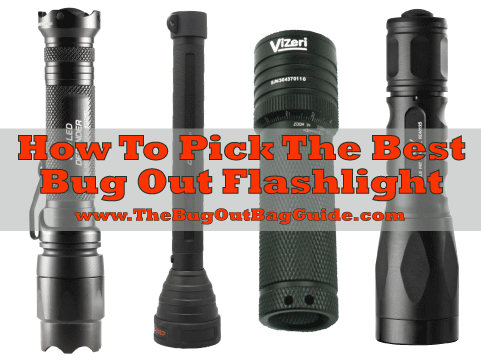
How To Choose The Best Survival Flashlight for Your Bug Out Bag

Best Survival Flashlight

Emergencies can happen in any place at any time, and it’s always better to be prepared in case the unexpected happens.

The last thing you want is to be left out in the dark.

Finding the best survival flashlight for your bug out bag is an important part of assembling your kit. There are a lot of options out there, and it can be difficult to find a good flashlight among all the noise.

In this guide, I will step you through the process of finding the best survival flashlight by looking at features, size, weight, battery type, and materials.

To save you time sorting through the huge variety of options out there I have made some recommendations to help you narrow down the best survival flashlights on the market.

FlashlightLumensLength/WeightFeaturesCost
Vizeri LED Flashlight

High: 2304.25"
3.68 oz
Includes a diffuser to convert the flashlight into a lantern. Flexible battery options.$
SureFire E2D Defender
High: 200
Low: 5
5.4"
3.68 oz
Crenellated front bezel & scalloped tailcap for self defense use. Switch has a "lock" mode to prevent accidental activation.$$$
Coast HP17TAC Flashlight

High: 615
Low: 64
13.12"
16 oz
Adjustable beam, a great mid-sized light that is well built.$$
Fenix PD35 Tactical Flashlight
High: 8505.47"
3 oz
Extremely bright flashlight. Very light weight. Flexible battery options.$$
Surefire P2X Fury

High: 500
Low: 15
5.4"
5.7 oz
Very high lumens for a small light. Switch has a "lock" mode to prevent accidental activation in a pocket or bag.$$$
Streamlight Survivor

High: 140
Low: 47
7.06"
13.1 oz
Designed to be used by firefighters in search & rescue. Rugged clip for attachment to your bag or person.$$
Coast HP21 Flashlight

High: 1317
Low: 207 lumens
15.5"
2.8lbs
Adjustable beam size from flood to spotlight.$$$$
Smith & Wesson Galaxy

High: 25
Low: 6.5
7"
6.08 oz
Lens contains 10 white LEDs and 3 red LEDs for multiple modes.$
Streamlight Protac Tactical Flashlight

High: 260
Low: 13
4.7"
4.8 oz
Comes with 3 modes but can be reprogrammed by the user. Great value.$

Our Picks For Best Survival Flashlight

Best Overall Bug Out Flashlight: Vizeri LED Flashlight

Best Survival Flashlight

The Vizeri LED Flashlight is a fantastic choice for a bug out bag flashlight.  It is a compact powerhouse that will not take up much room in your BOB, coming in at 4.25″ long and weighing less than 4 ounces.

This hand sized light still manages to pump out 230 lumens, more than enough to blind an attacker, light up a large area, or scare off an aggressive animal.

Additionally, it can take either AAA alkaline or 18650 Li-ion batteries to give you flexibility when trying to scavenge replacements in the field.

The Vizeri LED Flashlight proves its versatility again with its 5 output modes (high, mid, low, SOS, strobe), giving you the ability to signal for help, blast out a blazing light, or conserve energy.

On top of all this, the Vizeri LED Flashlight is weatherproof rated up to IPX-7, giving you confidence that it will illuminate your path in all conditions.

The features listed above are typically found in lights that are in the $150-200 range. The Vizeri LED Flashlight provides all this at a fraction of that.

Overall, a great survival flashlight at an amazing price.

Best Self-Defense Flashlight: SureFire E2D Defender

Best Self Defense Flashlight

The SureFire E2D Defender is an ideal self-defense flashlight that excels in both of its required tasks.

First off, the SureFire E2D Defender is a dual mode flashlight that can shine at a blazing 200 lumens for tactical situations or be toggled down to 5 lumens for discrete or energy efficient applications. The flashlight will shine for 1.9 continuous hours while in high mode and an astounding 76 hours in low mode.

The SureFire E2D Defender has also been smartly designed with a lock mode in the on its switch to prevent accidental activation while on the trail to keep your batteries saved for when you need them.

As for the self-defense potential of the SureFire E2D Defender, it has been thoughtfully crafted with your protection in mind.

The crenelated front bezel and scalloped tail are designed to intimidate on sight and magnify the force of a strike. There is no doubt that a blow from the SureFire E2D Defender will stop an aggressor in their tracks, whether animal or human.

Overall the SureFire E2D Defender is a fantastic multipurpose tool, providing outstanding illumination and effective self-defense options to any bug out bag or EDC kit.

Best Full-Size Flashlight: Coast HP17TAC Flashlight

Best survival flashlight

If you are looking for a full-size light for your BOB, the Coast HP17TAC Flashlight is an outstanding choice.

First off, it is extremely bright, pumping out a blinding 615 lumens in high mode and a respectable 64 in low.  The Coast Flashlight will effectively throw its beam a whopping 882 feet, just shy of 3 football fields.

The Coast Flashlight’s larger size allows for it to carry a larger battery supply. This translates into the best lifetime of any of the flashlights that we looked at. It will operate at its high setting for over 15 hours and coast along on low for more than 51 hours.

The other advantage of the larger size of this flashlight is that it can easily double as a blunt self-defense weapon. Measuring just over 13″ and weighing 1lb, you can swing this with confidence if your back is up against a wall.

The Coast HP17TAC Flashlight is powered by 3 D size alkaline batteries which make scavenging for replacements a relatively easy proposition in any populated area.

This is a great flashlight that is built well enough to light your way for years to come.

Flashlight Features and Considerations

Weight and Size

One problem that many people have when trying to figure out what to put in their bug out bag is dealing with the weight and volume constraints of their backpack.

Even small bags can get extremely heavy when they’re filled with survival gear.  Large bug out bags that become overly heavy can be far too difficult to carry and may even rip due to the weight.

To estimate the weight of your BOB, try our free bug out bag tool here.  Ideally, a bug out bag flashlight will weigh 16 ounces (1 lb) or less when fully loaded with batteries.

Another issue that is especially prominent in small bug out bags is the issue of space. A bug out bag is not very useful if a few large items are eating up all of the space. The key to dealing with this isn’t putting in fewer items, it’s finding smaller items that work just as well. Many people choose to buy small flashlights that fit easily in the palm of your hand such as mini-flashlights and keychain flashlights to have lightweight and effective lights that take up little space.

If you have plenty of room to spare, a rugged tactical flashlight can be a good choice. While being heavy is a benefit for flashlights that double as billy clubs, it’s best to avoid a bulky survival flashlight if you do not intend to use if for this purpose. Look for a light that is 8 inches or less in length to keep your BOB uncluttered, this should suit most survival needs.  If, however, you are looking for a flashlight that can double as a self-defense item you may want a larger model, as mentioned above.

Battery Type

When you use a flashlight as your everyday carry (EDC) flashlight, the type of battery you choose comes down to your own requirements and how you plan to use the flashlight (see the article on choosing the best EDC flashlight for your needs here). However, a flashlight that you plan to keep as part of your bug out bag will have a different set of requirements to consider when it comes to batteries.

An EDC flashlight, for example, is going to be used often and probably for relatively short periods of time, whereas a survival flashlight for your bug out bug will only be used in case of an emergency situation. In such a scenario, chances are that there will not be power available and you will need to use your flashlight for long periods of time. For this reason, alkaline batteries (AA, C, or D sized) would be the battery option I would recommend. And here is why – alkaline batteries are generally much more commonly available than high-end battery types such Li-ion batteries, while still providing enough power to your flashlight for an extended period of time.

When your battery power runs out, you can simply replace the batteries with new ones you have with you or that have been scavenged and carry on.

Alkaline batteries are not perfect, though. You need to keep in mind that alkaline batteries can lose power over an extended period of time and could leak battery acid when left in your survival flashlight for a long period of time, ruining your light. So if you do go the alkaline battery route, check the batteries regularly for corrosion or leakage. If you spot leakage, replace the batteries as soon as possible!

Bulb Type

When it comes to flashlights, you can’t get much better than LED bulbs. They’re brighter, clearer, last longer, are more energy efficient and far more durable than traditional incandescent light bulbs.

All these factors make LEDs a great choice for many uses including survival flashlights. LED bulbs are also a favorite for tactical flashlights as their intense brightness is good for blinding enemies.

Best Survival Flashlight

Flashlight Brightness

When it comes to buying a flashlight for your bug out bag, brighter is almost always better. Visibility is vital when it comes to survival situations. About 45 to 150 lumen is the preferred amount for many survival flashlights, but be warned that increased brightness means more strain on the batteries.

Note that if you are looking for a self-defense flashlight, a minimum of 100 lumens is needed for blinding aggressors.

Having a focused beam and a good reflector are also necessary for getting the most out of your light. Bigger bulbs and wider reflectors allow a larger area to be illuminated, which is good for lighting up eating areas, car interiors or small rooms. However, when the beam is wider the light doesn’t reach as far. Focused beams with narrow reflectors don’t illuminate as much, but the light extends much farther.

Having an adjustable beam will allow you to have the best of both worlds, look for this feature when finding the best survival flashlight for your bug out bag.

Best Survival Flashlight

Weatherproof Rating

It’s always a good idea to ensure that the flashlight will stand up to water, cold and hot weather, mud, ice and other adverse weather conditions as natural disasters are a common reason to need a bug out bag.  Weatherproof flashlights are especially beneficial to hunters, hikers and anyone who plans on using their BOB for wilderness use. Weatherproofing is typically expressed as an IPX rating from 1 to 8.

Look for a flashlight that is advertised as rated IPX-4 for basic water resistance and IPX-7 or 8 for a survival flashlight that can be submerged without damage.

Best Survival Flashlight

Construction Material

Anodized aluminum is a favorite of tactical flashlight users, but is it as useful for your bug out bag flashlight?

Most metal flashlights are sturdy, but some plastics can also be very strong and stand up well to various forms of damage. Metal conducts both cold, heat, and electricity while plastic doesn’t get very cold or hot in intense temperatures.

Metal can be quite heavy while plastic is fairly light. If you’re merely using the flashlight for illumination, plastic may be a better choice.

If you have the ability to use it as a self-defense flashlight, anodized aluminum will be a better choice.

Self-Defense Features

There are many survival flashlights that can be used as a billy club or kubotan as a means of self-defense against animals or other people. If you already have a reliable weapon such as a firearm, pepper spray, machete or EDC knife, you may not need a self-defense flashlight that acts in this way.

However, they’re still good to have as you can never have too many means of protection.

Additional Flashlight Features

Additional features can be useful when finding the best survival flashlight to meet your particular needs. For example, some flashlights have alternating colors for signaling, night-vision, tracking blood and more.

  • Multiple brightness settings can be useful for saving battery life or when you want to avoid drawing attention to yourself.
  • Brighter beam settings can are useful for signaling and potentially blinding enemies.
  • Clips for belts, lanyards, hats and more are great for convenience purposes. Having a headlamp or a hat clip for a flashlight can also allow for hands-free use in emergencies.

When looking at extra features for your survival flashlight make sure to find elements that are well suited to your individual needs.  This will help you effectively find the best survival flashlight to help YOU survive.

Conclusion

When looking for a survival flashlight for your bug out bag, the one that is the best choice is determined by the ultimate purpose of the light and the main application of your bug out bag.

The most critical factors to keep in mind are quality, brightness, battery life, and durability.

No matter if it’s a small light for a bug out bag that you keep in your car or a large tactical flashlight for a large bug out bag meant for longer term survival situations and outdoor use, those four factors should be the most important aspects to keep in mind for any bug out bag survival flashlight.

About The Author

This article was written by John Bee, who is the author of The Flashlight Guide.

Read More

bug out bag

Reader Case Study: Making Your Family More Self Reliant

Family Preparedness

I recently received an email from a reader with an inspiring and educational story about how he helps prepare his family. I thought it would make a great case study in applying the preparedness mindset to everyday life.

We live in upstate New York and just North of us are a series of 3 poorly maintained dams that have been in the news from time to time due to neglect and mismanagement problems. Most of us who live on the downhill side of these dams are always waiting for one to spring a leak in a big way. Since they are all in a row along the same river if the top one goes the others don’t stand a chance. Neither do those of us who live in the probable path.

Great work! Bill has looked around at his environment and assessed threats that are likely to affect him and his family. He can now plan how to mitigate these and prepare more effectively.

We have had bug out bags ready and stored in our front hall closet, right near the front door, for years now. We use PVC waterproof packs made for canoe and rafting trips. I make sure the gear is rotated several times a year with respect to seasons and since we have 3 kids, I need to make sure clothes still fit. I also stick in some playing cards and a book or 2 for each of us.

Bill has done a good job here helping his family prepare. He has:

  • Packed bug out bags for all members
  • He periodically checks and updates each kit for seasonal changes and growing kids
  • He has packed items to make an evacuation less traumatizing for his kids
  • He has packed the survival gear in a waterproof container to protect everything from the elements

At this point Bill shares a very personal anecdote of his preparedness journey with us as well as shares some practical tips for choosing and archiving important documents.

But what takes work and thought are the important documents and family photos that we would not want to lose. Call me a sentimental fool (my kids leave out the sentimental part) but childhood memories are important to me and can never be replaced. I looked into keeping family photo albums and important documents with a relative but decided against it. I also looked into a safety deposit box in a bank but that was expensive. The cheapest one I found was over $40.00 a month.

The solution I settled on was scanning each page of photos from all of the albums into our computer than burning them onto C.D.’s and flash drives and keeping a copy in each of the bug out packs. It was very time consuming and frustrating because I am not an expert at this. It really was in the truest sense of the word, a labor of love. We must have 6 thick photo albums made up of years of vacations, birthday parties, Halloween photos and much more. We even caught my son’s very first unassisted steps! I’d hate to lose this stuff. In addition to the photos, I have been writing letters to each of my children since months before they were even born.

I wrote about boring things mostly. How the garden was doing and what we planted. What the weather was like or what we were doing at work. But I also wrote about how we both looked forward to meeting them for the first time and hearing their first words. How we wanted to go hiking and canoeing with them, and how much we hoped they quickly found a job. (I think I’m funny). Before I even knew their gender, I did know I was going to cherish them everyday, and I have. I still do, even though my oldest son who just turned 15 is now 6 feet tall already.

So, after I figured out the technical details on how to scan things onto my PC, then burn them onto C.D.’s, the work started in earnest. Several long days it took me to do this and more than a little trial and error, with the emphasis on error. Still, I doggedly persevered. I scanned about 200 pages with photos on each page. Then I opened and scanned each letter I have written over the years.

Bill has put a lot of effort in to keep his family’s memories together. If things go badly and the dams he mentioned above break or there is another disaster his family can evacuate to safety knowing they will have their history and important memories with them. The story of how Bill writes letters to his children and wants to preserve these for them until they are old enough to appreciate them was particularly impactful for me. We often think of survival as a checklist of gear to buy or skills to master. I think this anecdote really shows the human side of surviving that is often overlooked. If a disaster does occur having these tidbits of their former lives will provide great strength and morale to Bill’s family.

On top of that I scanned things like health, life, homeowners and car insurance policies. Some of these need to be updated a few times a year, so I scanned them individually so when I need to put a more recent document in I didn’t have to scan 6 other things as well. I also included:
Wills
Health care proxies
Property surveys
Paperwork dealing with the purchase of the house
Birth certificates
Social security cards
Marriage license
Professional certificates
Resumes
Medical documentation
Blood types
Fingerprints
Recent family photos to assist searching for separated members

Bill has moved on to the practical stuff to archive here, things that will help his family rebuild in the aftermath of a disaster. He has a great tip in there as well of scanning documents that tend to be refreshed periodically as individual items that can be updated in a modular fashion, rather than having to re-scan the whole list just to update one page. This is practical advice from someone who has done the task themself. Thanks Bill, once again your efforts are an inspiration.

But even the most well stocked bags are not much good unless you have a plan your family knows about and maybe even practices. That is a critical part of being prepared. Anyone can throw some stuff in a bag but to be really ready you all need to be on the same page and know what to do and when to do it. That will make or break your survival sometimes. Knowing what skills your family members have and being able to rely on them to do what was agreed on ahead of time is a huge part of preparedness, at least to my way of thinking. It’s also the hard part. Not everyone will see your point of view or agree on the need to plan ahead. I face that all the time with my wife, but after a few tough situations over the years we have come to trust and rely on each other. That is also when you realize you have a great relationship that needs to be cherished and never taken for granted. Ever.

Bill has wisely looked beyond just buying a bunch of survival gear to get prepared. He recognizes the importance of having a simple, realistic plan to follow if disaster strikes. He has also involved his wife in the decision making process and gotten her buy in to the plan. Having the commitment of all the adults in your Bug Out Party is so critical as it allows you to work as a team. As Bill points out this can be a challenge if your spouse is not on the same page as you. Luckily he was able to persevere and gotten her on board.

It is a wonderful thing to have neighbors who look out for each other. Super Storm Sandy tore up our property and ripped over 10 large trees down, some on our roof. We bought a 650 gallon food grade water cistern years ago and had fresh water to share. Some shared gasoline (which was almost non existent) but just having someone to knock on your door to see how you were was a real blessing.

Preparing is great, but it is also vital to communicate your plans with family, friends and neighbors. I thought my neighbors would think me nuts for telling them our plans and suggesting they make plans of their own, but no one did. They were great and offered suggestions.

Bill is once again showing how a proactive mindset pays off in survival situations. In this anecdote he:

  1. Demonstrates the usefulness of proactively preparing his home by setting up a cistern. This can apply to many things, from upgrading your home like Bill did to going out and learning some additional survival skills. The quick win that will help you survive is adopting a PROACTIVE mindset rather than a REACTIVE one. Look around you right now, what can you change, adapt, or develop to make yourself better prepared?
  2. Bill talks about his relationships with his neighbors and how they looked out for each other in the recovery after Super Storm Sandy. If you have good relationships with the people around you, it can act as a force multiplier in your recovery or survival efforts. In this case Bill was able to share some of his water. Ask yourself, if there were a disaster in your area what would you be able to offer your community? Food? Firewood? Knowledge? Try to become an expert in something and you will have the ability to help others and in turn barter your skill/resource/advantage for whatever you need.

I hope this was of use to some folks. We had to learn most of the lessons the hard way, but learn we did. Not to share our lessons with others would be wrong. Be well my friends.

-Bill in New York.

Thanks for being so generous with your experiences and knowledge, Bill!

So, what can we take away from this case study?

  1. The fact that you read this blog is a strong indication that you already have a proactive mindset. If not, adapt to it as quickly as possible. Being proactive instead of reactive is one of the most fundamental aspects of survival. If you have to rely on yourself to survive waiting for things to happen will not get you very far.
  2. Help your family with prepping by doing things for them if need be. This may mean building bug out bags for everyone, scanning documents, and more as Bill has done.
  3. …But you can’t do it all yourself. Things like making your family’s Bug Out Plan simply cannot be done in a vacuum. Involve your spouse as early as you can. If you simply are not on the same page as far as the importance of preparedness consider doing as much as you can for them and then demonstrate the utility of your actions and how it helps the family.
  4. Involve your kids as well, teaching them skills will pay dividends for the rest of their lives. Additionally educating them about preparedness will make it less scary if you ever do need to actually rely on these skills as we mentioned in our article, Bugging Out With Kids.
  5. Communicate, communicate, communicate with your family. Let them know why you are preparing in addition to how to survive. Don’t get distant and do everything in isolation, show them that your actions come from the heart.

Reader Case Study Conclusion

I hope this case study was useful to you and gave you some ideas to help you along your preparedness journey. A big thank you again to Bill and his family for being so open and honest about the challenges and experiences they have faced so far.

If you have a story about your own path to preparedness or self-sufficiency please let us know in the Comments Section below or email Chris directly at info@thebugoutbagguide.com.

Always remember, chance favors the well prepared.

Read More

Survival Quotes

Inspirational Survival Quotes To Motivate Your Prepping

Like many endeavours prepping can be engaging and exciting in the beginning but start to lose its luster as time passes and life’s priorities get in the way.  Some people make prepping their lifestyle and seek to live in an independent, self sufficient manner.  Others make their bug out bag and pull it out for a once over only when a big event catches their eye in the news.  Either way keeping that momentum going and instilling a permanent preparedness mindset will keep you ready for when you need to initiate your bug out plan and draw on your survival skills.  To help inspire the flagging wills of burned out preppers we have compiled this list of survival quotes to get you motivated.

Winning Survival Quotes To Keep You Motivated

1. The only easy day was yesterday

Survival Quotes

Who said it?

Basically every Navy SEAL ever.  This is their motto.

Meaning

Every day is a new challenge and the only easy things are ones that are already completed.  If it was easy, they wouldn’t be sending The SEALs to take care of it.  Survival is the most difficult thing anyone can be called upon to do.  We are not accustomed to thinking about this because we are so far removed from day-to-day surviving in our modern world.  Being able to go to the grocery store and pick out a multitude of tasty foods that have travelled hundreds (or thousands) of miles without any effort from the consumer is truly a mind boggling thing.  However take this away and the unprepared person will turn desperate after missing 2 meals or less.  When you are relying on your own skills and wit to eke out your existence truly the only easy day was yesterday.  Every day in a survival situation is a battle for life itself.  Think of this when you are prepping, self preservation is the most motivating thing there is.

2. The guy on the street is sitting on his couch right now watching TV!

Survival Quotes

Who said it?

Emilio Garcia – Head instructor of the Mixed Martial Art Combat Fighting Systems

Meaning

This is a personal one for me as I trained with Emilio for 5 fantastic years.  He would yell this at us when we were face down on a dirty gym floor, too exhausted to do any more pushups or when you were sparring and someone wanted to quit.  Comparing what we were doing – pushing ourselves to our personal breaking points – to what our potential adversaries in a street fighting scenario were likely doing at that moment – sitting on the couch watching TV – was extremely motivating.  We knew that the more we sweated in the gym to prepare, the less likely we would be to bleed in the street.  In survival prepping the comparison is obvious.  You are investing your time now on weekends and nights after putting the kids to bed so that when you need to survive, you will be prepared.  Are you the person in the gym or the guy on the street?

Survival Quotes
The Author on the left. Don’t be the guy on the street.

3. I have not yet begun to fight

Survival Quotes

Who Said It?

John Paul Jones – Revolutionary War Naval Officer

Meaning

John Paul Jones is one of the most celebrated Naval officers of the American revolution and with good reason.  In addition to capturing multiple enemy vessels and leading daring raids on both British Controlled Nova Scotia and England’s home shores he drew enough animosity from the King to be labeled a pirate with the likes of Blackbeard!  Jones gave us this quote during a battle off the Scottish coast in September of 1779.  Although his ship, the Bonhomme Richard was burning AND sinking when told to surrender by the British commander he replied that he had not yet begun to fight!  He proceeded to whip the British fleet and accept their surrender within 3 hours of his response.  Moral of the story: when faced with dire odds dig deep and trust in your own abilities and skills.  You have prepared long and hard for the challenges ahead and you CAN overcome them.

4. Chance Favors The Well Prepared

Survival Quotes

Who said it?

Unknown, surely they were a prepper though.

Meaning

With all the chaos and uncertainty in the modern world it is impossible to predict what may come.  However if there is a terrorist attack or natural disaster in your area, it is the people who have prepared for it who will fare best.  Prepping is an investment in your future.  When you need to survive that investment pays off big time.

5. Nuts!

Survival Quotes

Who said it?

General Anthony C. McAuliffe, in response to the ultimatum of surrender from the German commander during the WWII Battle Of The Bulge

Meaning

On December 22, 1944 the American troops fighting around the town of Bastogne were encircled by German infantry and armor.  Recognizing his advantage the German commander of these forces sent a polite but forceful request to the American commander, General McAuliffe demanding that he surrender honorably or face annhilation.  General McAuliffe’s response was as terse as it was defiant, “NUTS!”.

The American troops managed to hold out under the brutal onslaught that followed until the 4th Armored Division arrived on December 26th to provide reinforcement.

This act of defiance can be a lesson to us all that even when all hope is lost there is still a way to survive.  Remember this when preparing your survival plan and developing your skills, it may be that your strength of will alone carries you and your loved ones through your next ordeal.

6. If

Survival Quotes

Who said it?

The Ephors (Leadership council) of ancient Sparta

Meaning

When King Philip II of neighboring Macedonia was preparing to invade Sparta he sent the following message, “You are advised to submit without further delay, for if I bring my army into your land, I will destroy your farms, slay your people, and raze your city”.  The Spartans responded with the gusto of the fearless with a simple, “If”.  King Philip ultimately chose not to test the Spartan’s will and moved on to easier conquests.

We could look to the Spartans for many inspirational survival quotes.  Although lesser known than the infamous “Molon Labe” (Come and take them – referring to his army’s weapons) Spoken by King Leonidas (of 300 fame) “If” equally demonstrates the Spartan’s both willingness to fight and confidence in their preparation and training.  We should all strive to reach this mindset in our prepping.  No matter what the threat – terrorism, home invasion, earthquake, or whatever else – IF it happens we are prepared to survive.

7. It’s not whether you get knocked down, it’s whether you get up.

Survival Quotes

Who said it?

Legendary football coach Vince Lombardi

Meaning

Coach Lombardi would say this to his players as a means of inspiring toughness and resilience in their mindsets.  It is a fantastic approach to disaster preparedness planning and many other aspects of life.  A survival scenario is dynamic and unpredictable by nature, there are going to be setbacks.  Set up your bug out plan to overcome these setbacks.  Develop your survival skills to be able to solve any problems that may be thrown your way.  You are likely to get knocked down in a survival situation mentally and possibly literally.  Be prepared to get back on and keep moving forward.

8. Out of every one hundred men, ten shouldn’t even be there, eighty are just targets, nine are the real fighters, and we are lucky to have them, for they make the battle. Ah, but the one, one is a warrior, and he will bring the others back.

Survival Quotes

Who said it?

Heraclitus, Greek philosopher and historian, 500 BC

Meaning

While one of the lengthier survival quotes it is also a personal favorite of mine.  While Heraclitus made the statement in reference to an army it is applicable to many situations.  Next time you are in a crowd look around and think about this quote.  How many of the people present are ready to survive should an emergency occur?  How many will panic?  How many will not know what to do?  Are you the 1-in-100 that will survive and thrive when the time comes or are you one of the 80 targets?  Your prepping and learning of survival skills should turn you into the warrior that brings your loved ones back.

Conclusion

I hope you liked our survival quotes.  If you are motivated to start building your Bug Out Bag click thru to our Custom BOB List Building Tool below!  This will let you pick what you want in your BOB from a list of survival gear, check the estimated weight, and then email the checklist to your inbox, all for FREE!  Click on the button below to give it a try:

Bug Out Bag Interactive Packing List

Your Thoughts?

What do you think of these survival quotes?  Do you have any survival quotes that you would like to share?  Please let us know in the Comments Section below.

Read More

Family Bug Out Bag

How To Make Your Family Bug Out Bag

Family Bug Out Bag

If you are a parent or plan on bugging out with family members that have children there are some important factors to consider when preparing for your potential evacuation.  This includes carefully packing a family bug out bag and making your family bug out plan compatible with the limitations presented by having young ones with your bug out group.  Here we will take a look at bugging out with infants, young children, and tween/teens to help you determine what to pack in your family bug out bag and how to best prepare your family unit to survive when the unforeseen strikes.

What Makes A Great Family Bug Out Bag?

A family bug out bag can differ from a typical solo BOB in a few important ways.  Although it has the same primary purpose of being a mobile kit to help you survive, it must be tailored to meet the needs of multiple people of various ages and skillsets.  Here are some items to add into your family bug out bag based on the ages of the children you will be evacuating with:

Family Bug Out Bag: Infants and Toddlers (Age 0-5)

Combination child carrier and pack

This will enable you to carry both your child and survival gear .  It is ideal to utilize one of these combination packs as an option for your family bug out bag if you have a toddler or infant that you are going to bug out with.  Having a combination child carrier/pack will enable you to carry everything comfortably and allow you to move further faster.

Osprey Packs PocoKelty Pathfinder 3.0Kelty Transit 3.0Vaude Wallaby 12L Pack


Diapers

This is obvious for anyone who has been a parent but it might be something that is overlooked when packing your firestarters, paracord, and other survival gear.  Reusable diapers are probably a better option.  Besides the fact that they are multiuse with some basic treatment, they are also multipurpose and can be put to many other tasks beyond their primary objective.

Medicine syringe/Eyedropper

This goes along with any medication you may be giving your child.  It may be as simple as a reflux medication but you do not want to have to improvise a delivery method while on the move.  Medicine syringes are lightweight and take up very little room.  If your infant may need to ingest any medication be sure to pack one.

Formula

You may pack rations or be able to forage and hunt for yourself but what about the little one?  Even if the mother is currently breastfeeding it is wise to pack some powdered formula.  This will enable another person to feed the child if the mother is separated or otherwise unable to do so.

Pacifier

If your child takes a pacifier having one packed in your family bug out bag will make sure it comes with you as you evacuate.  A pacifier may help your child sleep and will give you an option for keeping them quiet when maintaining a low volume is imperative.

Extra Clothing

As a rule of thumb pack your family bug out bag with 2 more sets of clothing for your child than you pack for yourself.  This will enable you to better regulate their temperature by using the principle of layering and give you options in the event of a diaper accident.

Waterproof Bodysuit

This is essential foul weather gear for your infant or toddler.  Keeping them warm and dry will go a long way in reducing parental stress and keeping morale high.  There are many options out there for this, make sure if you already have one that it is packed in your family bug out bag, not hanging in the closet.  Also be sure that if it has been a while since you last performed a review of your family bug out bag that this item (and any other clothing) still fits your growing child.

Pre-sterile bottles

These are bottles that are sold in sterile packaging.  It will save you from having to boil a bottle before feeding your child while on the move.  Be sure to keep track of expiration dates on any sterile items as a part of your regular bug out bag reviews.

Sterilization agent

This is generally sold in a concentrated powder or liquid form that is diluted with water.  If you have to use any bottle multiple times you will eventually need to sterilize them.  A few drops of sterilizing agent mixed with water in a nalgene or other wide mouthed water bottle can be used to sterilize bottles or other small items.

Bug Out Planning for Infants and Toddlers

It is essential to realize that you are going to need to carry your child for the overwhelming majority of your bug out.  Besides the physical limitations of toddlers and infants they may be emotionally or mentally traumatized by the event that caused the bug out and new surroundings.  This will lead them to be more needy and want to be in frequent reassuring contact with their parent.  As you will already be carrying your family bug out bag, the additional weight of your child has to be incorporated into your bug out planning.  It is necessary but it will ultimately slow you down and cause you to burn more calories.  Plan your energy intake and rest stops to account for this.

Noise reduction is an important aspect of operational security.  This clashes with the need for most young children to yell or cry to express their needs.  This means you need a strategy in place to keep your child quiet if a critical situation arises.  It may be as simple as giving them a pacifier or as advanced as giving them a dose of antihistamine or other substance that may make them drowsy (Talk to a doctor if you are considering this latter strategy!!!!).  Plan and prepare to avoid problems when you are on the road.

Family Bug Out Bag

Family Bug Out Bag: School Aged Kids (Age 5-10)

Non-battery powered toys

Keeping your school aged child’s hands and mind occupied will go a long way in making the situation more bearable for both you and them.  Plan on packing at least one non-battery powered toy in your family bug out bag to keep your child entertained when you set up camp for the night.  Ideally this item will have many uses and ways to interact with it.  Think simple, and light and a single toy, not something with many pieces like legos.  It is good to have your child pick this item and put it in the family bug out bag themselves as it will help them understand that it is a special toy they are setting aside as part of the family’s preparedness planning.

Comfort item

Kids this age know enough to pick up on the cues around them to know something is wrong.  Pack a familiar item for them in your family bug out bag to comfort themselves with.  This may be a favorite toy, blanket, or stuffed animal.  Having something they are used to interacting with will make the bug out situation less overwhelming for them and reduce parental stress.

Child’s Bug Out Bag

School aged kids will be able to carry their own backpack with a few supplies to take a small amount of the load off the parents.  You may be able to pack some of their clothes or other lightweight items in their pack or split up some of the group’s basic essentials such as rations or other survival items amongst the gear they are carrying.  Be careful not to overload the child, 5 lbs worth of gear is a good guideline.  If you load them down and tire them out quickly you are going to have to carry them AND the gear.

Bug Out Planning for School Aged Kids

A child at this age can begin to contribute towards the family’s prepping.  They will be able to undertake many tasks while under adult supervision such as collecting firewood, setting up camp, foraging, and many more.  This is also a good age to instill the prepping mindset in kids.  Have them tag along as you build your bug out plan and pack your family bug out bag to get their minds working.

Starting to learn basic survival skills is an excellent way to involve kids as well.  Train them in basic first aid to start off with.  This means they will be able to provide some assistance if the parent gets hurt.

It is wise to put photos of the family in the pockets of school aged children.  In the event you are separated, they will be able to show these to authorities or other people they encounter to help find you again.

At this age kids also begin to spend time away from their parents at school.  Because of this it is important to drill into them where to meet if a disaster occurs.  As we cover in our How To Make A Bug Out Plan Article, this may be a specific office or classroom but what is important is they know what to do when the bug out plan is initiated.

Lastly although school age kids can show some initiative and take on some responsibilities it is important to recognize that at some point in your bugging out the parent will most likely have to carry them.  This may be due to exhaustion or just facing difficult terrain.  Regardless of why you need to be prepared to do this and have a family bug out bag packed in a manner that does not prohibit carrying your child.

Family Bug Out Bag

Family Bug Out Bag: Tween and Teens (Age 10-18)

Teen/Tween Bug Out Bag

Kids in this age group should be able to carry at minimum all their own personal gear that makes up your family bug out bag.  This may be their spare clothes, rain gear, and any tools that are specifically for their use such as a hunting or self defense item.  Get your teen or tween a backpack made to fit their smaller frame.  Make sure it is a quality bag that is able to be carried comfortably and cinched tight to their bodies, not a cheap school book bag.  We provide tips on how to pick the best backpack in our article here.

Hunting Tools

Teens and Tweens are old enough to be taught at minimum proper weapon safety, care, and use.  Note that this does not have to be a firearm, if you are uncomfortable with giving a minor a gun you can still teach them to fend for themselves with a slingshot or bow and arrow.  Have them practice accuracy and stalking as a part of your regular preparedness exercises so they are ready to catch dinner when you are bugging out.

Knife

A knife is one of those basic tools with nearly limitless applications.  A kid in this age group should be taught how to safely carry, use, sharpen, and care for a knife.  Pack a knife for your teen in your family bug out bag or have them carry it with them in their pack.  There are numerous tasks that a teen can carry out using this to assist the welfare of the bug out group as a whole.

Bug Out Planning for Teens and Tweens

As teens are entering the first stages of adulthood this is a great time to start giving them some responsibility.  They should be able to understand the seriousness of a bug out situation and grasp that all bug out group members need to pitch in and help.  As you prepare at home challenge them to make decisions in a controlled environment. Doing this will teach them to take responsibility for the well being of the family.  Teens are also able to learn more advanced skills such as:

Kids in this age group are able to take on more autonomous tasks to be carried out when on the move and when setting up a camp.  Teach them to take ownership over basic tasks such as gathering firewood, finding and treating water, and foraging for food.

Teens are also able to understand that a bug out situation can be very dangerous and that they may need to defend themselves or their family members.  If you are comfortable and knowledgeable in self defense or weapons training it would be wise to pass this information on to older teens in a responsible manner.

Family Bug Out Bag

Family Bug Out Bag Conclusion

Bugging out with children of any age adds challenges to an already difficult situation.  However as you can see with some simple planning you can overcome these difficulties and help your family evacuate safely.  Think critically about what items to add to your family bug out bag to make things easier on both the child and the parent.  Also include your kids in your preparedness training and bug out planning so they know what is going on when the time comes.  If you are interested in more details on making a Family Bug Out Plan, I recommend checking out this comprehensive ebook:

Family plan

Your Thoughts?

Do you have any items that you would add to your family bug out bag?  Is there any special planning that you would do to make sure your family can bug out safely together?  Please let us know in the Comments Section below.

Read More

Best EDC Bag

How To Choose The Best EDC Bag

Best EDC Bag

Choosing the best EDC bag to contain your every day carry items is an important part optimizing your day-to-day preparedness.

There are many brands, styles, features, and sizes of bags out there, and in this article, we will help you identify what to look for as well as what to avoid when selecting the right bag for your EDC kit.

Step 1: Choose Your EDC Items

Before choosing an EDC bag, we need to go over exactly what gear we plan to carry.

Whether you are new to the idea of Every Day Carry or someone who has been carrying a kit around for years, take this as an opportunity to reassess your EDC needs.

We cover this process in depth in our How To Make An EDC List article but we will recap here for your convenience.

Let’s perform our EDC list review by asking ourselves following questions.

1. What items do you NEED to carry with you to accomplish your basic daily routine?

These are the basic items that you can’t leave your house without. These items usually include a wallet, keys, and cell phone. You may require more than this based on where you live or what you do professionally.

Keep this list as minimal as possible, it will be the core of your EDC kit, and we will add on from here.

2. What are the threats, risks, and common problems that you are likely to face on a day-to-day basis?

We covered how to perform a risk assessment in the article we mentioned above (here), but the basics of this are to take a look at your environment and identify what potentially negative events are most likely to occur.

Part of knowing this is to understand what has happened historically in your area as well as paying attention to evolving risks around you.

Once you have a list of medium to high probability risks, add to this the commonly occurring problems in your daily life.

  • Do you need to frequently open boxes or packages? Would carrying a knife help you with that?
  • Is it common for you to be in dark areas or to be out late at night?

Maybe it would be a good idea to start carrying an EDC flashlight (Check out our article here on the best EDC flashlights).

What we are looking to address here are items that address common problems and high probability risks.

Think critically about these two elements and be shrewd about what you plan on packing.

3. What could you carry that would be universally useful in many situations?

This follows the philosophy of carrying multipurpose survival items.

What items could you carry that have many uses?

Items like duct tape, paracord, and a multitool fit perfectly into this category. Is there anything that you can add to your every day carry bag that fits this profile?

4. What items do you want to carry to assist with a low probability/high impact situation you may have to face?

These items are ones that are nice to have but not things that you hope to have to use except in less common circumstances.

They may include emergency tools such as a seatbelt cutter/window breaker for escaping vehicles, a spare handcuff key, or a pry tool for forcing doors open.

Do you have to walk through a rough neighborhood on your way home from work every? Maybe carrying pepper spray would be prudent?

Consider low-probability events with a high, negative impact that you could greatly improve your survivability by having a simple tool.

Best Bug Out Bag

Carefully consider the questions above when crafting your EDC list.

Keep in mind that you are not striving to solve every problem or cover every possibility with your EDC kit, for that you will want a full Bug Out Bag.

Keep your EDC kit as simple and effective as possible.

If your intention is to carry these items with you EVERY DAY, you do not want a bloated list of gear that you carry around and never use.

Step 2: How Big Should Your EDC Bag Be?

After determining your ideal every day carry list, figuring out the best EDC bag size to contain it is relatively straightforward.

I suggest finding the smallest bag that can fit all your items, once discounting any items that you may decide to carry in your pockets.

Start by measuring the largest item. Its size will be the minimum dimensions of your EDC bag. Also, consider if you will be adding any items to your EDC kit on an occasional basis such as rain gear, water bottles, food, documents, or anything else you will be carrying as the need arises.

You will want extra space or the option of modular additions through a MOLLE system or other method to fit these occasional items. EDC bags come in many styles and sizes, from a small organizer pouch that can fit into a cargo pocket up to 30-liter backpacks. Anything larger than this is moving into Get Home or Bug Out Bag territory.

If you require a bag larger than 30L, you either have some BIG EDC items to carry or may want to re-examine your EDC list.

Step 3: Choosing the Best EDC Bag Type for You

There are many types of bags used for Every Day Carry purposes.

Here is a list of the most common EDC bag types:

EDC Organizer Pouch

An EDC Organizer Pouch is the smallest style of EDC bag. This is for people who have too many items to simply carry in their pants pockets but not enough to require a pack.

It’s hard to go wrong with the OneTigris Compact MOLLE EDC pouch.

EDC organizer pouches typically:

  • Are 1 liter or less in volume
  • Have many interior pockets, hooks, and webbing for organizing EDC gear
  • Have MOLLE attachment points for integration into larger kits
  • Fit in a cargo pocket or are worn on a belt

Common EDC items that are stored in an EDC organizer pouch include:

We recommend: The OneTigris Compact MOLLE EDC Pouch

EDC Lumbar Pack

EDC Lumbar Packs are larger than organizer pouches but smaller than a sling bag or backpack. This is useful if you plan on carrying larger items or a greater quantity of smaller items.

Because this style of bag does not strap around the shoulders and arms it may be the best EDC bag option for someone who needs a full range of motion.

Best EDC Bag
The Maxpedition Proteus Versipack is compact and has a well thought out layout. Click the image above for more info.

EDC Lumbar Packs typically:

  • Are 5-10 liters in volume
  • Are worn around the waist but also have a carry handle if you need to carry them by hand
  • Have MOLLE webbing both to attach them to larger bags or to attach smaller pouches to the lumbar pack
  • Have multiple compartments which will each contain various webbings, pouches, and hooks for organizing your EDC gear

Items typically carried in an EDC Lumbar Pack include anything that is mentioned above in EDC Organizer Pouch list plus:

We recommend: The Maxpedition Proteus Versipack

EDC Sling Bag

An EDC Sling Bag is typically used to carry heavier items than a lumbar pack due to its over-the-shoulder design. They are made to be comfortably carried further with a heavier load and can be the best EDC bag choice for someone who has many items to haul on a day to day basis.

Best EDC Bag
This Tactical Hip Bag is excellent for medium sized EDC Kits. Click on the image for more info.

EDC Sling Bags typically:

  • Are 10-20 liters in volume
  • Have MOLLE integration
  • Allow left or right side carry
  • Are easier to secure tightly to the body than a lumbar pack
  • Have many pockets and compartments that allow for easy organization of every day carry gear

In addition to the items listed to be carried in an organizer pouch and lumbar pack, items that can be carried in an EDC Sling Bag include:

  • Extra ammunition
  • Small Laptop
  • Mid-sized Medkit
  • Prepackaged Meals
  • Paracord
  • Fire Starting Kit
  • Pry Tool

We recommend: The Red Rock Outdoor Gear Hipster Sling Bag

EDC Backpack

An EDC backpack is perfect for someone who likes to pack lots of “just in case” gear. It is the obvious choice for anyone who has large sized every day carry items or a long EDC list based on their EDC needs.

The RUSH12 is a popular backpack that has plenty of compartments, a hydration pocket, and MOLLE integration.

EDC backpacks typically:

  • Are 20-30 liters in volume
  • Have MOLLE integration
  • Include hydration bladder systems
  • Have fewer pockets but more modular customization possibilities for external pouches

In addition to the items listed for the 3 bags already covered, every day carry items carried in EDC Backpacks include:

  • Folding Saw or Hatchet
  • Hydration Bladder
  • Change of Clothes
  • Full Sized Laptop
  • Full Medkit
  • Mini survival kit

We recommend: The RUSH12 Backpack by 5.11

Step 4: Features You Need and Features to Avoid in an EDC Bag

We suggest carrying the smallest bag that suits your every day carry needs.

Fortunately, many of the best EDC bags come with customization options to add or remove space as you need it via modular MOLLE pouches so your EDC bag can evolve with your requirements.

Regardless of what bag style you choose here is a list of features to seek out and avoid when finding the best EDC bag for your needs.

Essential Features

High-quality craftsmanship

If you are planning on carrying the best EDC bag EVERY DAY you do not want something cheap that is going to fall apart on you. Invest in a quality bag from a brand that has a good reputation and it will pay dividends.

MOLLE integration

MOLLE integration is a valuable feature to have in any tactical or preparedness bag as its widespread use allows for limitless customization options. Having it as a part of your EDC kit, regardless of the bag size and style that you choose will allow flexible adaptation as your EDC needs evolve.

Hydration system

This applies to sling bags and backpacks. Having a hydration system built into the bag will save space and reduce the need to carry a separate water bottle. Hydration is essential if you have to cover large distances with your EDC bag.

Adjustable fit

Every body is different. Buying a bag that is meant to fit all people is a recipe for frustration and discomfort. Your EDC bag needs to fit your body shape securely and not restrict your movement.

This means having multiple adjustment straps and clips at the following points at a minimum:

  • Shoulders
  • Hips
  • Sternum

Being able to adjust the fit of the bag at these 3 points will ensure that you have a securely fitting bag that you can wear all day, every day if need be.

Ability to run with the bag

This goes hand in hand with having a well-fitted bag. You never know when you need to run with your bag, you may need to catch a bus or evade detection from unfriendly people.

Either way, having a bag that both stays in place and does not jumble your EDC items around is an important feature to look for when choosing the right EDC bag for your situation.

Organization pouches within the bag

A good indication that you have a high-quality EDC bag instead of a more general consumer style bag is that it has well laid out, accessible, and practical organization features built into the bag.

This helps you find your EDC items when you need them and allows you to organize them in the manner that is most logical to your EDC needs.

Most quality EDC bags come with a variety of webbing, pouches, velcro, zippers, sleeves, and compartments that allow for efficient storage of your items.

Tough, corrosion resistant zippers

The zipper is a weak point in any bag. Being that you will use them thousands of times over the life of the bag it is important that your EDC bag has quality zippers that will not get stuck or break on you.

Additionally, it is better to have zippers and pulls that are made from a strong plastic, aluminum, or other rust-free material.

If you are carrying this bag every day it will at many times be exposed to the elements. Over time this will cause corrosion and failure in cheap zippers. Zippers are where cheap manufacturers will look to cut corners.

The best EDC bag makers on the market know that a quality zipper can mean the difference between a reliable bag and a piece of junk.

Features to avoid

As important as the above mentioned Essential Features are to include it is also necessary to be aware of features to avoid when finding the best EDC bag for you.

One large compartment

If you are going to carry your carefully selected EDC gear in a bag that has one large compartment you might as well just tote around a burlap sack. It will be cheaper and accomplish the same thing – jumbling your gear so you can’t find what you need in an emergency and making for an uncomfortable carry.

Choose a bag with multiple compartments and organizational options within the bag to optimize the accessibility of your EDC items and better manage the load.

Elastic straps

This is a way that cheap bag makers cut costs. Instead of making strong, padded, adjustable straps they will use elastic ones that make the bag a one-size-fits-none. Additionally, the elasticity of these will wear out over time making the bag hang lower than desired.

If a bag uses elastic straps to attach it to your body avoid it at all costs. Look for robust shoulder and hip straps with adjustable buckles for comfortable, long lasting fit.

Huge bags

Once again, even the best EDC bag is not intended to cover every possible circumstance. This is what your bug out bag is for. Carefully assess your every day carry needs and try these tips to minimize what gear you will be carrying:

  • Review your EDC list of items and see what you actually use on a day to day basis and what you can cut out.
  • Utilize multipurpose items to save space and weight
  • Try to find lightweight options for the items that you do carry that are constructed in materials such as titanium, micarta, carbon fiber, and plastics
  • If an item comes in multiple sizes choose the smaller version – small medkit versus full sized or folding knife versus fixed blade

Finding The Best EDC Bag For You

As you can see, the journey of finding the best EDC bag to meet your every day carry needs is a highly personal choice.

You will have to balance the threats you are likely to face with what you are able and willing to carry with you every step of the way. Once you have come to a decision of what your EDC kit will be it is best to find a high-quality bag that is comfortable and small enough to not encumber you if you need to move quickly.

Having a smaller, lighter kit with useful, practical items is more desirable than having a huge bag full of items you are unlikely to ever use.

Plan you kit thoughtfully and choose the best EDC bag you can to meet YOUR needs.

Remember, chance favors the well prepared.

If you want to read more on putting together your EDC kit, check out our related articles on:

Want Even MORE Info On Building Your EDC Kit?

If you are looking for even more information on how to build your ultimate EDC kit you can check out my book, The Every Day Carry Guide. It is a comprehensive manual that will teach you:

  • How to be prepared at all times – no matter where you are
  • How to build your first EDC kit from scratch
  • How to refine an existing kit to make it more effective
  • How to pick the best gear to realistically make you more prepared
  • How to assess threats and risks in your everyday life

EDC-Book-w-Button

Where to Go From Here: Pack Your Bug Out Bag

Once you’ve developed your EDC kit, if you haven’t done so yet, you should consider preparing a bug out bag.

We are the most comprehensive source for bugging out and take pride in our helpful Bug Out Bag List to help you pack!

Your Thoughts?

What do you think the best EDC bag is? Are there any features that you think are essential for EDC bags?

Please let us know in the Comments Section below, thanks!

Read More