Best Multitool For Backpacking & Survival

best multitool for backpackingJust by reading this, you’re showing that you’re likely all about organized and efficient daily preparation. Most dedicated preppers and EDCers will take a certain pride in getting the greatest amount of performance out of the smallest and most efficient possible package. Many of us also pride ourselves on being the person who can, under almost any circumstance, immediately find a creative fix for any problem.

When it comes to packing a lot of usability into a single unit, the only thing that comes close to a prepper’s ingenuity is a well thought out multitool. An appropriate multitool can offer a solution that will make quick work of unexpected jobs, solve minor problems, or get you out of a tight jam with minimal hassle.

With all the cool multitools on the market, making the final selection can be tough. Whether you’re looking for the best pocket tool for your EDC kit, the best multitool for backpacking, or the best survival multitool, we’ll help you make the right choice. We’ve put together a comprehensive guide to deciding the right one (or three!) for you. Read on to find your ideal tool for every job!

Types of Multitools

Multitools can be had in any number of configurations. If there’s a need, there’s a multitool to fit. Multitools can be simple one-piece affairs or complex 20-tool behemoths. Between these extremes are tools to fit every need or desire. Let’s look over a few of the basic styles:

Folding Multitools

These are the full sized multitool style popularized by Leatherman, Gerber, and countless other brands.  When someone says “multitool,” this is what first comes to mind for most folks. They’re designed like a pair of collapsible pliers with tools that fold out of each handle. When not in use, the handles both swivel up butterfly-style and nestle together around the plier head.

These multitools typically offer the largest number of and most stoutly built tools, and invariably include those handy pliers or large scissors. The folding handles will often also provide some sort of locking function for tools so as to prevent accidental closures. Generally these multitools are a little big and bulky to be carried in a pocket, so they’ll come with a cloth, leather, or Kydex multitool pouch for belt carry.

We recommend: The Leatherman 830850 Skeletool CX Multitool

best multitool for backpacking review leatherman skeletool
Click the image to see the best price for the Leatherman Skeletool and user reviews on Amazon

Pocket Multitools

Just because you carry a big tool doesn’t mean you have to look like one; a belt mounted multitool pouch isn’t for everyone. Following the pattern of the classic Swiss Army Knife, pocket multitools can offer as many tools as a folding multitool, but are generally much less bulky and don’t require special carrying considerations. The flip side of this is that most of the tools don’t lock in the open position, and there’s rarely anything more than a perfunctory scissor or plier option.

We recommend: The Victorinox Swiss Army SwissChamp Pocket Knife
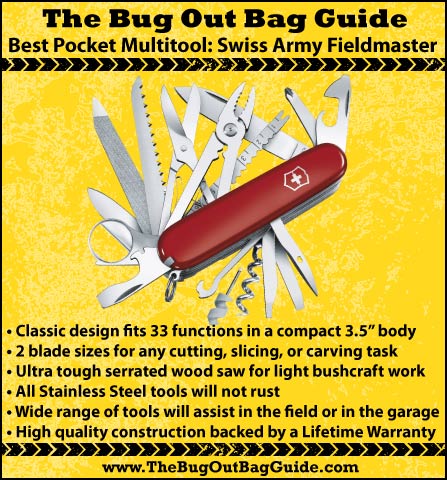
best multitool for backpacking Best pocket Multitool review fieldmaster
Click the image to see the best price for the Swiss Army Fieldmaster and user reviews on Amazon

Keychain Multitools

Designed to be ultra-small and easy to carry, keychain multitools are typically found as super compact versions of the folding or pocket multitool styles. The Victorinox Classic or Gerber Vise would be excellent examples. These small multitool options usually trade having a large variety of tools for easy portability.

We recommend: The Gerber 31-001134 Dime Micro Tool

best multitool for backpacking best keychain Multitool review gerber dime tool
Click the image to see the best price for the Gerber Dime and user reviews on Amazon

One-Piece Multitools

These are the smallest, least complex, and most lightweight multitools out there. They’re really nothing more than a small piece of steel or titanium that has been shaped and scalloped to provide several commonly used tools in a super simple, durable form. One-piece multitools generally provide a bit of leverage for prying, a flathead screwdriver, and a bottle opener. Popular offerings include the Atwood Prybaby, the Gerber Shard and the Leatherman Brewzer.

We recommend: The Leatherman Brewzer

best multitool for backpacking review leatherman brewser
Click the image to see the best price for the Leatherman Brewzer and user reviews on Amazon

Wallet Multitools

Inexpensive, easy to store, and packed with great functionality, these ultra-thin multitools have been gaining popularity as of late. These are not typically designed for regular use, instead offering a nice last-ditch option that will rarely be forgotten due to its ease of storage in something you’re rarely without: Your wallet.

Typically, these tools are equipped with a sharp edge that can pass for a blade, a number of low-profile wrenches, a bottle opener, and a ruler. The idea is thin functionality that can go wherever you do.

We recommend: 11-Function Stainless Steel Survival Pocket Tool

best multitool for backpacking review Wallet tool
Click the image to see the best price for the Credit Card Wallet Knife and user reviews on Amazon

Specialty Multitools

The lightweight “EAT’N Tool” from CRKT is particularly cool, designed as a lightweight spork equipped with a bottle opener, pry tool, and a few wrenches that do duty for stove maintenance.

best multitool for backpacking review crkt eatn tool
Click the image to see the best price for the CRKT Eat’n Tool and user reviews on Amazon

Tool Options

When it comes to options, most multitools have plenty. Generally all multitools will offer a few basics, including a blade, can and bottle opener, and flathead screwdriver. From there, the options open up in every direction. The Victorinox brand pocket multitool is famous for its little bitty toothpick and tweezers. The full sized multitool style nearly always provides relatively large pliers or scissors. Many choices have an ever handy corkscrew for impressing the ladies on impromptu picnic trips.

Each multitool finds its own niche by offering different combinations of options. When searching for just the right one, keep your eyes open for multitools equipped with carabiners, pocket clips, replaceable tools, vise grips, magnetic drivers and bits, integrated smartphone stands (yes, seriously!), or clever weight-saving measures. Any of these items might be just the ticket in your search for the best survival multi tool.

best multitool for backpacking
The best survival multi tool puts an entire workshop in your pocket.

In true prepper style, always be considering alternate uses for tools. A magnifying glass, for instance, can be used for starting fires, while magnetic screwdrivers could be used to construct a field-expedient compass. These uses might not come in handy every day, but when they do you’ll be extra thankful for them.

All this being said, don’t mislead yourself into thinking that there’s any one multitool that can truly do it all. Expect to carry one multitool for EDC, another one for camping, a day at the range, or to be left in your BOB. Still another may be the best survival multitool or the best multitool for backpacking or fishing with the family. Each has its place, and each can provide the right tools for certain settings.

Decision Making Factors

Buying the right multitool is a challenge.  A lot is riding on the choice, and there are so many options available. When you’re browsing the myriad options intent on finding your ideal multitool, you’ll have lots to consider. Your decision making process for any multitool should take into account each multitool’s functionality, suitability, and ease of use.

best multitool for backpacking
Which tools do YOU need in a multitool?

Functionality

First off, ensure the multitool you’re looking for has all the parts and tools you need. You’re aware that there are all kinds of cool multitools with onboard magnifying glasses, flashlights, and the like. The real question is whether these are necessary for your usage.

While it’s easy to over-tool, it’s not tough to under-do it either. It’s often tempting to go super simple, but make sure you still end up with enough tool to get your jobs done. Of course, the environment in which you’ll most be drawing upon your multitool’s functionality will go a long way toward impacting your choice. If you’re looking for a tool to carry and use every day at your retail job, something like the Victorinox Midnite Minichamp, with its integrated package opener and ballpoint pen, might be a good bet.

If your idea for a multitool is more about general preparedness with a focus on easy portability, then maybe a Leatherman Micro is the right choice. For cooking on the trail, the best multitool for backpacking should include utensils and openers. One way or the other, you might have more trouble finding a multitool that you can’t put to use than finding one you can!

Suitability

All the features or tools in the world aren’t going to justify your multitool selection if the multitool doesn’t adequately fit your intended usage. Consider also how easy the multitool is to carry. For instance, if you never wear a belt you likely won’t find yourself sporting a multitool pouch.

best multitool for backpacking
The blade on a pocket multi tool is essential when building a fire or constructing a shelter.

Likewise, if you’ve got large blacksmith’s hands and are expecting to be performing lots of tough tasks at construction job sites, a keychain multitool probably isn’t your ideal option. While the best multitool for backpacking might include specially shaped pot-gripper pliers on a really lightweight multitool, it may be too specialized for good EDC.  Perhaps a smaller pocket multitool or a multitool with a pocket clip would be better suited to everyday use.

To learn more about assessing your EDC needs, CLICK HERE.

Ease of Use

Make sure your multitool is easy to put to work. Fumbling around to get your multitool out of your pocket or to open a commonly used tool is going to end up being really irritating in no time. As such, consider a multitool with a pocket clip.

If you think you’ll be using the bottle opener a lot, make sure that particular tool folds out quickly and easily, maybe even requiring the use of only one hand. When multitools are too difficult to use effectively, they aren’t serving their purpose. Make that tool earn its keep.

Common Mistakes When Buying a Multitool

As with any purchase, it’s easy to be led astray when searching for the right multitool. Oftentimes folks will order what was expected to be their ideal tool sight unseen. When it arrives, they’ll find that it’s overly complicated to use, too large or heavy to carry comfortably, suffers from poor construction and materials, or has a layout that’s difficult to use or just plain inconvenient.

To avoid this, get your hands on as many tools as possible before you purchase. Poke around at your local sporting goods and hardware stores, consult your friends, and even check out an online multitool forum or two.

When you get a chance to play around with some multitools, remember to carefully consider how you’ll be carrying your multitool, what features you expect to be using most often, and whether you’ll really need some of the fancy extras that may be offered. If trying a few multitools in person is not an option, at least make sure you purchase your multitool from a reputable dealer with a good return policy.

Special Considerations

Sometimes buying and carrying cool multitools isn’t as fun as it sounds. Keep your head up and remember to consider the law and your bank account before committing.

Legality

When you’re purchasing or carrying a multitool, remember to think about where you’ll be traveling. Certain locales have pretty strict laws or statutes regarding knives, including restrictions on blade length, locking mechanisms, or carrying methods. In particular, know that TSA has reneged on their 2013 allowance of small blades on airplanes. As of early 2015, knives of any shape, size, or mechanism are not allowed on planes by TSA.

For folks that still want to be as prepared as possible, never fear: Industry is here! A number of savvy manufacturers have begun offering TSA-compliant multitools. Check out the Victorinox Jetsetter or Leatherman Style PS for bladeless multitool options.TSA-EDC-Kit-Intro3

Price

If you’re looking for a cheap multitool, carefully weigh your pros and cons. While the “three-for-one” deals at the Lowe’s checkout counter are tempting, they rarely offer the quality of a proper multitool. If you’re just wanting an extra light-duty toy to use in non-crucial scenarios, then perhaps giving in to consumerism and getting that cheap multitool isn’t such a bad thing.

Your friends here at TBOBG certainly aren’t immune to such temptations, as can be evidenced by the assortment of multitools collecting in every gear box and junk drawer. If you’re going to be using your multitool for real EDC or in the woods or other hard-use scenarios, though, you’re likely better off investing in higher quality tools.

Most well respected multitools are priced in the $40-100 range. This also usually includes a good warranty; Gerber offers a lifetime warranty, and Leatherman is well known for honoring its 25-year coverage. Your wallet might not thank you in the short run, but the performance and durability of a good multitool will well outweigh the short term cost.

That About Does It

You’re now as qualified as anyone to make the final decision regarding your new multitool purchase. Just keep in mind your prospective uses, consider the tool’s abilities and limitations, and enjoy the process. It’s tough to beat the feeling of carrying an entire toolbox on your person at all times, but let’s make sure they’re the right tools for the job.

Your Thoughts?

Do you have a favorite multitool? Which features do you use most often? Have you encountered any drawbacks in quality or design? Let us know in the Comments section below, thanks!

Read More

best hiking headlamp

How To Choose The Best Hiking Headlamp For Bugging Out

best hiking headlamp

In a survival situation, timing is everything. The extra couple seconds it takes you to reach something in your pack can very literally mean the difference between life and death – especially if that item is needed for first aid or self-defense. Having both hands available at all times can be a huge advantage, and a great way to ensure you can maneuver hands-free is by wearing a headlamp.

In survival situations, headlamps (or headtorches, depending on where you hail from) are extremely convenient and useful, as well as having a variety of applications outside of survival situations including outdoor / camping adventures and home projects.

However, there isn’t a one-size-fits-all approach, different circumstances will require headlamps of a certain quality. While you may not be concerned with the quality of headlamp you’re using to complete repairs in your garage, you’ll definitely want to ensure the one in your bug-out-bag is the best headtorch for your needs.

In this article, we delve into the key features that differentiate the best headtorches from the mediocre, what you should look for in a headlamp, and provide our top picks for:

  • The most powerful / best LED headlamp
  • Best hiking headlamp
  • Best camping headlamp
  • Best compact headlamp

Choosing the Best LED Headlamp

The primary function of a headlamp – whether it be for camping, home use, or survival – is hands-free illumination. There are a variety of add-ons that come with certain models, but generally, an LED headlamp is not considered a multi-use item.

Why use a headlamp? Consider the various situations you may find yourself in and how hands-free illumination could make those situations substantially easier. If you’ve ever tried to set up camp in the dark or quickly reach supplies in your pack, you know the value of having both hands free. If you find yourself in a power outage, a great hiking headlamp will allow you to navigate a dark basement and check the breaker or make repairs quickly and easily with both hands at your disposal.

Best hiking headlamp
Be sure to have the best LED headlamp when navigating tight spaces. Photo by darkday.

In a survival situation, LED headlamps can also function as excellent signalling devices – particularly those with either a strobe or SOS setting – and are less likely to be dropped or lost as they are strapped to your head. Additionally, the use of LEDs has led to brighter lighting and longer lasting battery life, meaning that most of the best headtorches can be used for several hours a day for well over a month before their battery power runs out.

So what qualities should you look for when searching for the best headtorch? Your priorities may differ depending on whether you are looking for the best hiking headlamp, best camping headlamp, or best LED headlamp; and ultimately, how you intend to use your headlamp. Generally, when choosing the best headtorch, you will want to look for the following: brightness, distance and battery life; comfort, weight, and size; and IP rating for water resistance, IK ratings for shock resistance, and durability.

How Powerful Should Your Headlamp Be?

Brightness

The brightness of your LED headlamp will determine how far you will be able to see, and how far you need to see is determined by the specific activities you intend to use your headlamp for and your climate. In some cases, a headlamp with exceptionally long range may not be necessary if the tasks you will be performing are close at hand, such as reading and repairs. However, if you intend to use your LED headtorch for tasks such as scavenging for supplies or monitoring your perimeter for security, you will definitely want a headlamp capable of scanning long distances. Additionally, the climate you live in can play a role in the brightness required from your headlamp as light travels furthest in dry air; therefore, an arid climate would require less light than a humid one.

Best Hiking Headlamp
The best hiking headlamp or best camping headlamp for outdoor use does not necessarily need to be brighter than 100 Lumens.

Distance

To ensure you have an available option for almost any visibility scenario, select a headlamp with a combination of floodlight and spotlight settings. A floodlight can light up an entire campsite while the focused beam of a spotlight can pinpoint a distant object. Additionally, strobes can be very useful for signaling as well as running in the night, while an SOS signal can be vital in a survival situation.

Battery Life

In a survival situation, preserving battery power will be essential, as will having more than one battery option. Many survivalists opt for headlamps with both white and red LEDs to maximize battery life. The red light setting can be used for low-light tasks such as reading, as this setting is both easier on the batteries and eyes. Brighter lights will run your batteries down faster, so if finding a power source will be an issue, you may want to cut back on the Lumens or numbers of LEDs in your headlamp.

best hiking headlamp
Cooking at night is made easier with a camping headlamp. Red LEDs provide enough light for grilling dinner and won’t drain the batteries. Photo by Jim Sher.

Balancing Comfort and Size

Much like your bug-out-bag, for your best headtorch choice, you want to select one that is both comfortable and lightweight, especially if you will be traveling frequently at night.

Comfort

If you plan on wearing your headlamp for extended periods or while you are running or climbing, a top strap can be a desirable option as this adds stability. Whether or not you choose to wear a top strap, make sure to adjust the band so that it fits snugly enough to keep the light in place while you shake your head. To eliminate neck strain, choose a headlamp with an adjustable light angle.

bug out bag size

Weight

Both the number of lights and type of battery will affect the weight of your headlamp. Make sure that the model you choose is the best headtorch for your needs and of a weight that you can reasonably support for an extended period of time.

Size

The more LEDs, the brighter your light – but with each additional LED you are adding to the overall size and weight of your headlamp and increasing the draw on your batteries. Depending on your needs, decide what the ideal size and number of LEDs is that you can reasonably support without the headlamp being too heavy or depleting the batteries too quickly.

Does It Stand Up To The Elements?

Water Resistance

The IP rating refers to Ingress Protection Marking or International Protection Marking. It rates the protection of mechanical and electrical parts against solid particles and liquids. If there is an ‘X,’ this signifies that there is no rating available for this criteria, as in the case of IPX4 where the ‘X’ indicates the item is not dust rated and has a water resistance of 4 (meaning it can withstand splashing but not submersion).

best hiking headlamp
The best hiking headlamp should be able to withstand rain and occasional dunks. Photo by Jussarian.

Shock Resistance

The IK rating refers to mechanical impact and measures how many joules of downward force the object can endure. For the majority of consumer products, shock resistance ratings are typically given in meters, indicating the height at which the item can be dropped from and still withstand the impact.

Durability

For durability, choose an LED headlamp that has fantastic impact resistance, especially for use in survival scenarios.

Please see the table below for IP and IK ratings:

IP- 1st #ProtectionIP - 2nd #ProtectionIKProtection
0None0None00None
1Solid objects over 50 mm1Vertically falling droplets (rain)01-05Impact <1 joule
2Solid objects over 12 mm2Direct sprays 15 degrees from vertical (slanting rain)06Impact 1 joule
3Solid objects over 2.5 mm3Direct sprays 60 degrees from vertical (small splashes)07Impact 2 joules
4Solid objects over 1 mm4Spray from all directions08Impact 5 joules
5Limited protection against dust5Low pressure jets from all directions09Impact 10 joules
6Total protection against dust6Strong jets or splashes10Impact 20 joules
7Submersion up to 1 meter
8Long periods of immersion under pressure

Our Top Picks For Best-In-Class Headlamps

Most Powerful / Best LED Headlamp

Our Pick: Fenixlight HP25R

Review:

  • A clear winner on brightness, with 1000 lumen maximum output
  • It runs on rechargeable batteries, which can last up to 1.5 on turbo or 96 hours on eco mode
  • There are multiple light options including four levels of steady floodlight and three levels of steady spotlight, resulting in twelve different combinations, as well as an additional SOS strobe option
  • There is a 60 degree tilt mechanism with a lockout design that prevents the headlamp from accidentally turning on while packed in a bag
  • It is impact resistant up to one meter with an IPX6 waterproof rating and a sturdy aluminum chassis designed to shed heat and handle impact
  • A drawback of this model is its weight – at 8 oz., without batteries, this is one of the heavier headlamps available; however, the weight is supported by a center strap and balanced with the battery pack on the back
  • This headlamp does not contain any red LEDs but can dim to 4 Lumens

Best Hiking Headlamp

Our Pick: Vitchelo Waterproof IPX6

Review:

  • At a mere 3.2 oz., this headlamp packs a powerful beam of light into a compact design that takes up very little real estate, making it the ideal choice for the best hiking headlamp
  • It has a high waterproof rating and separate buttons to control the red and white lights, both of which can be set to steady or flashing (for a total of six lighting modes)
  • There is an adjustable tilt of 45 degrees that directs light where you need it
  • This headlamp will run on three AAA batteries (included) and provide up to 120 hours of lighting
  • A moderately priced option, this is your best pick for a hiking headlamp

Best Camping Headlamp

Our Pick: Black Diamond Icon

Review:

  • The Black Diamond Icon is our choice for the best camping headlamp as it has the most options for lighting scenarios and a lock mode to prevent it from switching beams while on the move
  • It includes one quad power, two single white LEDs, and two single red LEDs, which emit as much as 200 Lumens over a distance of 100 meters; this provides more than enough light to set up camp or search for firewood in the dark, and the two red LEDs are bright enough for reading and other low-light tasks
  • There is a dimmer that precisely adjusts your lighting and a strobe setting for signaling
  • At IPX7, you can feel free to traverse a waterway without worrying about losing the use of your light
  • This headlamp is lightweight and comfortable; it includes a removable strap that can be added for stability or customizing the fit over a hat or other headgear
  • There is a handy battery life indicator that will let you know when when there is 50% and 20% of power remaining, providing you with ample warning to adjust your light level if need be, i.e. prolonged use is required
  • This headlamp can be powered by four AA batteries (included) or a rechargeable NRG battery (sold separately)

Conclusion

A reliable, quality headlamp not only makes an excellent addition to your survival gear, but also to your general equipment for outdoor activities and daily tasks.

The benefits of having a dedicated light source that stays put while you are hiking, running, or climbing, are endless; as are the benefits of being able to work freely with both hands while maintaining constant illumination.

When choosing the best LED headlamp for your needs, make sure to select one that provides an adequate level of lighting in a model that fits you comfortably.

Look for headtorches that have multiple light settings and angle adjustability, as these qualities will increase the versatility and usefulness of your headlamp. Additional considerations, especially for outdoor use, are the levels of water and shock resistance and having more than one battery option available.

Always remember, chance favors the well-prepared – and especially the well-equipped!

Your Thoughts?

Do you own a headlamp? Would you choose a headlamp as your primary light source for your bug-out-bag? What benefits or drawbacks do you feel are most significant?

Share your thoughts in the Comments Section below, thanks!


Read More

Drones: A Prepper’s Guide

Drones-For-Preppers-Intro

Inspiration for new preps can come from unexpected places sometimes.  This happened to me when I was last visiting my parents and had the opportunity to take my Dear Old Dad’s quadrocopter drone for a test flight.

The drone, a Phantom 2 by DJI was a blast to fly around.  It also sported an HD camera that took high quality footage of us and the surrounding area.  It was surprisingly easy to control, even for a novice (me).  Watching the drone soar got me thinking, are there any applications to prepping that a drone could be used for?

How Would A Prepper Use A Drone?

I gave it some thought and came up with a few specific situations where having a drone on your side would be handy.  Most of these center around bug in scenarios as no one is going to want to haul around a power source or copter when bugging out.  In particular, using your drone to patrol or inspect your perimeter or the surrounding area would be a huge advantage to have.

Note: This is not intended to be an exhaustive overview of drone technology or all of the models that are available.  But, if you are planning on bugging in, it may be worth giving a drone some thought.

Me taking Dear Old Dad's drone for a spin.
Me taking Dear Old Dad’s drone for a spin.

Defending Your Perimeter

Your first line of defense in protecting your premises will be to build a perimeter security system that will alert you to the presence of trespassers and help you to prepare for any conflict – providing you with the upper hand defending your home.

In addition to this, having a drone on hand to inspect damage or investigate a disturbance would be a major advantage. While the use of drone technology for surveillance dates back to WWI, only recently has it become accessible for private use. With fitted cameras, sensors, and state-of-the-art flight capabilities, drones are showing that their usefulness extends well beyond simply serving as a hobby for aerial enthusiasts and photographers.

What Is a Drone?

Any unmanned aerial vehicle (UAV) or remotely piloted aircraft (RPA) is considered a drone. The majority of commercial drones are multirotors, with the most popular being quadrocopters (4 rotors). Most modern drones can be fitted with a camera to provide the operator with a bird’s eye view of the flight path, and some modern commercial drones come equipped with cameras already.

Drones are not merely military devices that function as insanely fun toys for the masses. They also have practical commercial applications including monitoring livestock, pipeline security, road patrol, search and rescue, wildfire mapping, videography and anti-piracy. As drones have the ability to pursue a manually-operated or automated flight pattern, they make ideal tools for homeowners to safely surveil their property without putting themselves in harm’s way.

Additionally, drones can be fitted with a variety of supplementary features including speakers, tasers, mace, and infrared or night vision cameras. For some models, flight paths can be monitored through smartphone and tablet apps.

Benefits of Perimeter Security

Effective perimeter security allows you to monitor what’s happening around your property from the comfort of your home or shelter and provides you with advance warning of any trespassers, giving you the upper hand.

Depending on the cause and length of your bug in situation, your property may become a target for other survivors, desperate to take your supplies by any means possible. When determining your security needs, consider your location in respect to its proximity to civilization and roadways, as the more accessible you are to others, the more of a target you become.

Other factors to consider when planning your perimeter security include the following:

  • Is there limited visibility caused by terrain or structures
  • Do you have an expansive property that can be easily approached from many directions
  • Are you located near a major roadway where travelers might have to abandon vehicles and continue on foot
  • If you are bugging-in in a suburban setting, are your neighbors close by
  • If you are bugging-in in an urban setting, how is your visibility of the area surrounding your building
drone-prepping-3
Would be pretty sweet for perimeter defense…

Why Use a Drone For Perimeter Security?

In terms of perimeter security, drones provide several advantages over mounted cameras or simply patrolling the property yourself, including mobile video surveillance, remote control and stealth.

Mobile Video Surveillance

Unlike a mounted camera, which is fixed on a designated area, drones are mobile and provide an unlimited field of view. The real-time video surveillance capabilities of a drone provide the ability to immediately assess whether a disturbance is a threat or welcome members of your team.

Remote Control

The ability to operate and control the drone from a distance not only keeps the operator out of harm’s way, but also facilitates the surveillance of large areas in a short amount of time and of areas that would be treacherous to travel by foot.

Stealth

Drones are generally very quiet and have long range view capabilities. Additionally, drones cannot be avoided or tampered with as can a mounted camera.

One drawback to drones is that, yes, they can be shot down by an intruder. But most people would much rather lose their drone than their own life.

What Type Of Drone Would A Prepper Buy?

You can find drones that sell for as little as $50, but if you want a durable, top-rated model, you’ll need to spend at least $1,000 or more. Drones can be purchased ready to fly or in kits that you assemble. If you plan on adding several of your own features, a do-it-yourself drone is probably the best option; in fact, several brands offer a modular design that adapts well to add-ons.

When purchasing your drone, consider the following:

  • Maneuverability
  • Durability
  • Ability to live stream (first person view) vs. recording you can watch later – this decision comes down to personal preference and circumstances

Look for drones with the following features:

  • Gimbal to stabilize video
  • HD cameras
  • Long stream broadcast distance (more than 100 yards)

Here is a video taken by drone to give you an idea of the scope and range of what an operator can see when in flight: 

What Features Should I Look For In a Perimeter Defense Drone?

There are a variety of different features that can be added to drones, the best ones for you depend entirely on your situation and particular circumstances. For instance, drones come with varying levels of user control, with the most extreme being completely autonomous drones that patrol without any human interference.

Depending on your needs, an autonomous device may be ideal or you may want some level of manual operation to check on specific disturbances.

When choosing a drone for perimeter defense, here are some useful features you should consider:

  • Detection software, which can be installed to recognize perimeter breaches and immediately send the drone to the vicinity of the breach. Additionally, this software can be synched with an invisible infrared geo-fence, motion detectors, or seismic sensors, that can all be positioned in key locations around your property.
  • Flight time charge, this is a crucial factor as you want to ensure the desired flight path can be accomplished with a single charge.
  • Safety features, including proximity sensors that will detect and avoid objects in the flight path, emergency landing gear in the event of mechanical failure, and a ‘return-to-base’ function in the event the battery is low or the connection with the controller is lost.
  • Video, this can be displayed on the controller, streamed to a smartphone or tablet, or connected via video goggles for a first-hand, virtual reality experience. If you won’t be actively monitoring the flight path, you can also have the data sent to a DVR for viewing at another time.
If you see one of these above you it is probably too late...
If you see one of these above you it is probably too late…

OK, So Which One Should I Choose?

The ‘best’ drone for you depends entirely on your particular needs; what is an optimal choice for one person may not necessarily serve the needs of someone else. The following are our top drones picks along with the relative benefits of each, review each keeping in mind your particular circumstances to determine which would be the best fit:

DroneFeaturesCost
DJI Phantom 2 Vision+

• Ready to fly and easy to operate out of box
• Flight time of 15-20 minutes
• Three-axis camera stabilization
• Shoots full HD video
• Controller is smartphone compatible for viewing video and adjusting camera settings
$$$
Parrot Bebop

• Flight time is approximately 10 minutes
• Can be controlled with an iphone or android device; alternatively, a SkyController can be purchased for $400 providing joystick controls, extended range, and HDMI output
• 14 megapixel camera with 180 field of view fisheye lens that automatically stabilizes the image, removes the fisheye effect, and sends image straight to a smartphone
• Records up to 8GB of 1080p video directly on the device
$$
3D Robotics X8+

• Offers 15 minutes of flight time
• 8 motors with 11” propellers
• Can lift 2 lbs. and has a sturdy design
• Modular platform allows for customizing; does not come with camera or gimbal, but these can be added
• “Follow me” gps tracking feature links to your smartphone
$$$
Hubsan Spyhawk FPV

• Spy plane design
• Front-facing camera • Built in LCD display on the controller
• Three-axis flight stabilization
$
Drone in Action - Chaotic Unmanned Personal Intercept Drone (CUPID)
CUPID
• Not yet available on market
• Sends live video feed to a smartphone
• Can locate an intruder and incapacitate them with 80,000 volts of electricity (see video!)
$$$$
ArizonaFPV The Copper Copter
ARIZONA-FPV-COPPER-COPTER
• Offers 10 minutes of flight time between charges
• Programmable
Camera included
Only available from the manufacturer
$$$$

What Else Should I Consider Before Investing in a Drone?

Remember that in a bug-in situation, power will be a scarce resource. As drones are battery powered, battery life should be a top consideration as well as having an alternative power source at your bug-in location. For instance, in the case of power grid failure, drone surveillance would be rendered useless without some other means of providing power.

power grid failure
What To Expect During A Power Grid Failure

Another consideration to keep in mind is government regulations regarding drone usage. As drones are an emerging technology, the FAA is drafting regulations concerning their usage. The most recent information states that a UAV (drone) must:

  1. Weigh less than 55 lbs.
  2. Always remain within the visual line sight of the operator
  3. Have a maximum speed of 100 mph (87 knots)
  4. Not be operated within 5 miles of any airport

In some situations, you may also need a license to operate one. While these regulations will be of little concern in a SHTF situation, be aware of them now to ensure you stay in compliance while practicing with your UAV.

Conclusion

Drones can be an excellent choice for perimeter security but involve a significant financial investment and require a decent amount of electrical and aerodynamical knowledge to maintain. Drones are also highly dependent on having a readily available electrical power source, an option that may not always present itself in every bug-in scenario. If you are considering using a drone for perimeter security, it is also important to keep an eye on the development of FAA regulations, which are only in the early stages.

The technology to remotely surveil your property and protect your family and supplies from intruders is here now, and it will only continue to improve. If you have a large property and are planning to bug in, a drone may be a smart investment. Always remember, when it comes to survival, chance favors the well-prepared.

Your Thoughts?

Have you ever owned or operated a drone? Would you consider using a drone for perimeter defense? Share your thoughts with us in the Comments Section below, thanks!

Read More

best slingshot

The Best Slingshot For Survival Situations

best slingshot

If you hear the word ‘slingshot’ and images of a mischievous Bart Simpson come to mind, you’re not alone. Although sling-type devices have been around since biblical times (remember how David slayed Goliath?), modern slingshots are engineered like never before and are considered legitimate weapons.

Out of the various slingshots that we’ve reviewed, we recommend The Scout Hunting Slingshot as the best well-rounded slingshot for survival situations.

In this article, we are going to take a look at what survival situations a slingshot can be an essential tool as well as what qualities to look for when choosing the best slingshot for your bug out bag.

Should I Add a Slingshot to My Bug Out Bag?

Lightweight and versatile, slingshots make an excellent addition to any bug out bag, and the best part is you don’t need to pack ammo!

Whether bugging out in the wilderness or an urban environment, projectiles for your slingshot can easily be scavenged. Not only will you not be weighed down by packing extra ammo in your bug out bag, but you won’t need to worry about running out.

When bugging out in the wilderness, nearly any rock will serve as usable ammo; however, riverbeds are probably your best bet for finding smooth stones that will fly well.

If you find yourself in an urban survival situation, there are plenty of sources for ammo including building debris and concrete, or, if you’re lucky enough to come across one, items from abandoned hardware or sporting goods stores.

However, if you do have space to spare, then packing some steel slingshot ammo isn’t a bad idea.

Slingshot Uses in Survival Scenarios

The two best most applicable uses for a slingshot are hunting and self-defense; making it a versatile survival tool.

Slingshot as a Hunting Weapon

For those who have never hunted with a slingshot, it may seem like a laughable concept, but rest assured that a good slingshot is capable of killing most small game (squirrels, rabbits, birds, etc.) from 30 feet away.

The following are some advantages of using a slingshot to hunt small game:

  • Gives you a small profile and makes it harder for animals to spot danger
  • Makes it easier to maneuver through brush to improve your shot or conceal yourself
  • Its completely silent – won’t give away your location to other animals or unfriendly humans nearby

The slingshot is a great choice for feeding yourself on small game but what about larger game, or fish? A good slingshot can take care of them too.

If your group is large enough that a couple squirrels simply won’t suffice, you can easily modify your slingshot to shoot arrows and take down bigger game.

You can also catch fish through slingshot fishing – a modified form of bow fishing that usually requires adding a reel to the slingshot, especially if you intend to fight the fish. Here is a how-to video if you are interested in learning more about slingshot fishing:

Slingshot as a Self-Defense Weapon

Don’t discount the power of slingshots in conflict (remember David and Goliath?) – they can be excellent survival weapons against both aggressive animals and humans.

Some of the advantages of using a slingshot as a survival weapon include:

  • Its small size, which makes it easy to conceal until you need it
  • Even just brandishing it and showing an attacker you are not unarmed can be enough to show you aren’t an easy target
  • Ammo can be easily acquired in the field making it a great choice for long-term survival
  • No need to worry about keeping it dry
  • Silent firing – you can stealthily take down targets without alerting any collaborators

best slingshot

If you’re still on the fence about whether or not a slingshot can be an effective self-defense weapon, consider that in recent history it has been used by various irregular forces including the Irish Republican Army and Ukrainian Anti-government protesters – this certainly demonstrates the slingshot’s effectiveness in modern conflicts.

The Best Survival Slingshot: The Scout Hunting Slingshot

You will want your slingshot to be accurate, powerful, and durable.

The Scout Hunting Slingshot delivers on all three of these requirements.

The Scout’s heavy duty flat bands allow for accurate, high-velocity shooting when stalking prey. Paired with some scavenged ammo, or 3/8″ steel slingshot ammo, The Scout Hunting Slingshot is a force to be reckoned with.

It is 100% American made and utilizes a classic design upgraded with indestructible, modern materials. For example, its glass filled nylon construction provides an extremely durable frame while remaining lightweight.

The Scout is designed with an ambidextrous grip that fits just right for any sized hand.

The Scout Hunting Slingshot a great choice if you are looking for a reliable way to feed yourself with small game or birds while on the trail. Naturally, The Scout can also be used as an effective self-defense weapon.

Its sub-$50 price point delivers great value and makes it a smart addition to any survival kit.

Want to see The Scout in action? Check out this video that demonstrates just how accurate it is…

Features to Look for in a Slingshot

If you’re experienced with a slingshot, then you know what a valuable survival weapon it can be. What you may not know is that not all slingshots are created equal; there are distinct features that make some more suited to a survival situation.

Let’s take a look at the different considerations to make when choosing a slingshot:

  1. Frame Material
  2. Band type
  3. Other Features

Frame Material

Generally, slingshots are made from three materials: metal, wood, and plastic. For your reference, I’ve listed the benefits and drawbacks as well as key considerations of each material to help you choose the best slingshot for your needs.

Metal

  • Metal slingshots are light and strong
  • They will generally be the most expensive but are far sturdier and last longer than wood or plastic
  • For a BOB, an aluminum or steel slingshot with a plastic or ergonomic foam handle is the ideal choice

Wood

  • A wooden slingshot is the most classic design
  • They are generally engineered with a simple Y-shape and a rubber band attached to each fork

Plastic

  • Different plastics can have very different qualities
  • Plastic slingshots are often more economical
  • Modern plastics such as glass filled nylon can be an incredible choice for durability and weight

Band Type

The two types of bands you will see in modern slingshots are flat bands and rubber tubing.

The determination of which is best for your survival needs really depends on what you intend to use the slingshot for – tubing may be better for hunting due to its durability, while flat bands provide better accuracy and would serve better as a self-defense weapon.

The benefits of each are as follows:

Rubber Tubes

  • Tubes tend to last longer; they would be the better choice if you are planning to use a hunting slingshot to feed yourself over an extended period of time
  • There are many types of slingshot tubes to suit any desired draw weight, check out the guide below:

best slingshot tubes

Flat Bands

  • Flat bands are easier to draw and typically produce a faster projectile speed; if you won’t be firing a lot but want better accuracy when you do, this may be a better choice
  • Flat bands would be a good self-defense option when making an evacuation that may require you to deter aggressive people
  • Flat bands tend to be faster and more accurate than tubing due to their rapid “snapback speed” – the rate at which the projectile is propelled forward

Both tubing and flat bands are relatively cheap –  if you are seriously considering a slingshot as a survival weapon, it may be worth experimenting with a few different types to find the best fit for you.

Other Features

The best slingshots have several features that differentiate them from the mediocre ones.

Some features are relevant for a survival or hunting slingshot, others less so, let’s take a look at the best slingshot features:

Grip

  • No matter what the use, having a comfortable grip is an essential feature for any slingshot
  • A grip will let you fire more shots and increase accuracy by reducing hand and wrist fatigue
  • When choosing the best slingshot, look for one with a contoured handle that fits your hand naturally

Sight

  • A sight helps to improve the accuracy of your shots
  • This is a great feature for someone with little experience as it can reduce the amount of time you need to dedicate to improving accuracy. However, don’t assume that just because you have a sight you will instantly become an accurate shot – practice still makes perfect!
  • If you will be aiming at lots of small targets, such as small game, a sight is a key feature
  • If you expect to be aiming at large targets, such as humans, at shorter distances for self-defense, a sight becomes less necessary
  • Most of the best hunting slingshots will come with a sight attached

Hollow Handle

  • Many slingshots come with a screw-cap hollow handle that can be used to store almost anything, from spare rubbers to ammunition
  • You can also use a hollow handle to store survival gear, similar to the hollow handle of a survival knife
  • While not a necessary feature, a hollow handle can be quite useful if you think carefully about what could be packed in there (fishing kit, items to make fire, button compass, etc.)

The Best Slingshot For You

When it comes to choosing the “best slingshot,” we really like The Scout Hunting Slingshot, but it comes down to your own personal preference.

After reading this guide, now that you’re more informed on the various nuances in various slingshots, you’re able to make an educated decision.

Final Thoughts

A slingshot is a versatile tool that can be used by both male and female preppers, from teenagers to seniors; slingshots are especially advantageous for preppers who aren’t comfortable with firearms or don’t have the size and strength to wield a hand-to-hand weapon.

However, like anything in life practice makes perfect. It does take some time to become accurate, but time is really your only investment as ammo – rocks, spare nuts or bolts, nails, etc. – is free!

Remember, practice is essential for proficiency!

While its simplicity is part of its appeal, the slingshot is a skill-based instrument that requires practice in order to get good. So take your time, practice all you need and develop your skills on this unassuming “toy” that could very well play an integral role in your survival.

Even if you decide a slingshot is just not the right fit for your bug out bag and survival plan, I would still suggest grabbing one as they are a lot of fun to play around with.

What do you think?

Do have a slingshot in your bug out bag? Is there a particular slingshot that you love? What do you think are the best slingshot features for a survival situation? Let us know in the Comments Section below, thanks!

Read More

How To Choose The Best Survival Flashlight for Your Bug Out Bag

Best Survival Flashlight

Emergencies can happen in any place at any time, and it’s always better to be prepared in case the unexpected happens.

The last thing you want is to be left out in the dark.

Finding the best survival flashlight for your bug out bag is an important part of assembling your kit. There are a lot of options out there, and it can be difficult to find a good flashlight among all the noise.

In this guide, I will step you through the process of finding the best survival flashlight by looking at features, size, weight, battery type, and materials.

To save you time sorting through the huge variety of options out there I have made some recommendations to help you narrow down the best survival flashlights on the market.

FlashlightLumensLength/WeightFeaturesCost
Vizeri LED Flashlight

High: 2304.25"
3.68 oz
Includes a diffuser to convert the flashlight into a lantern. Flexible battery options.$
SureFire E2D Defender
High: 200
Low: 5
5.4"
3.68 oz
Crenellated front bezel & scalloped tailcap for self defense use. Switch has a "lock" mode to prevent accidental activation.$$$
Coast HP17TAC Flashlight

High: 615
Low: 64
13.12"
16 oz
Adjustable beam, a great mid-sized light that is well built.$$
Fenix PD35 Tactical Flashlight
High: 8505.47"
3 oz
Extremely bright flashlight. Very light weight. Flexible battery options.$$
Surefire P2X Fury

High: 500
Low: 15
5.4"
5.7 oz
Very high lumens for a small light. Switch has a "lock" mode to prevent accidental activation in a pocket or bag.$$$
Streamlight Survivor

High: 140
Low: 47
7.06"
13.1 oz
Designed to be used by firefighters in search & rescue. Rugged clip for attachment to your bag or person.$$
Coast HP21 Flashlight

High: 1317
Low: 207 lumens
15.5"
2.8lbs
Adjustable beam size from flood to spotlight.$$$$
Smith & Wesson Galaxy

High: 25
Low: 6.5
7"
6.08 oz
Lens contains 10 white LEDs and 3 red LEDs for multiple modes.$
Streamlight Protac Tactical Flashlight

High: 260
Low: 13
4.7"
4.8 oz
Comes with 3 modes but can be reprogrammed by the user. Great value.$

Our Picks For Best Survival Flashlight

Best Overall Bug Out Flashlight: Vizeri LED Flashlight

Best Survival Flashlight

The Vizeri LED Flashlight is a fantastic choice for a bug out bag flashlight.  It is a compact powerhouse that will not take up much room in your BOB, coming in at 4.25″ long and weighing less than 4 ounces.

This hand sized light still manages to pump out 230 lumens, more than enough to blind an attacker, light up a large area, or scare off an aggressive animal.

Additionally, it can take either AAA alkaline or 18650 Li-ion batteries to give you flexibility when trying to scavenge replacements in the field.

The Vizeri LED Flashlight proves its versatility again with its 5 output modes (high, mid, low, SOS, strobe), giving you the ability to signal for help, blast out a blazing light, or conserve energy.

On top of all this, the Vizeri LED Flashlight is weatherproof rated up to IPX-7, giving you confidence that it will illuminate your path in all conditions.

The features listed above are typically found in lights that are in the $150-200 range. The Vizeri LED Flashlight provides all this at a fraction of that.

Overall, a great survival flashlight at an amazing price.

Best Self-Defense Flashlight: SureFire E2D Defender

Best Self Defense Flashlight

The SureFire E2D Defender is an ideal self-defense flashlight that excels in both of its required tasks.

First off, the SureFire E2D Defender is a dual mode flashlight that can shine at a blazing 200 lumens for tactical situations or be toggled down to 5 lumens for discrete or energy efficient applications. The flashlight will shine for 1.9 continuous hours while in high mode and an astounding 76 hours in low mode.

The SureFire E2D Defender has also been smartly designed with a lock mode in the on its switch to prevent accidental activation while on the trail to keep your batteries saved for when you need them.

As for the self-defense potential of the SureFire E2D Defender, it has been thoughtfully crafted with your protection in mind.

The crenelated front bezel and scalloped tail are designed to intimidate on sight and magnify the force of a strike. There is no doubt that a blow from the SureFire E2D Defender will stop an aggressor in their tracks, whether animal or human.

Overall the SureFire E2D Defender is a fantastic multipurpose tool, providing outstanding illumination and effective self-defense options to any bug out bag or EDC kit.

Best Full-Size Flashlight: Coast HP17TAC Flashlight

Best survival flashlight

If you are looking for a full-size light for your BOB, the Coast HP17TAC Flashlight is an outstanding choice.

First off, it is extremely bright, pumping out a blinding 615 lumens in high mode and a respectable 64 in low.  The Coast Flashlight will effectively throw its beam a whopping 882 feet, just shy of 3 football fields.

The Coast Flashlight’s larger size allows for it to carry a larger battery supply. This translates into the best lifetime of any of the flashlights that we looked at. It will operate at its high setting for over 15 hours and coast along on low for more than 51 hours.

The other advantage of the larger size of this flashlight is that it can easily double as a blunt self-defense weapon. Measuring just over 13″ and weighing 1lb, you can swing this with confidence if your back is up against a wall.

The Coast HP17TAC Flashlight is powered by 3 D size alkaline batteries which make scavenging for replacements a relatively easy proposition in any populated area.

This is a great flashlight that is built well enough to light your way for years to come.

Flashlight Features and Considerations

Weight and Size

One problem that many people have when trying to figure out what to put in their bug out bag is dealing with the weight and volume constraints of their backpack.

Even small bags can get extremely heavy when they’re filled with survival gear.  Large bug out bags that become overly heavy can be far too difficult to carry and may even rip due to the weight.

To estimate the weight of your BOB, try our free bug out bag tool here.  Ideally, a bug out bag flashlight will weigh 16 ounces (1 lb) or less when fully loaded with batteries.

Another issue that is especially prominent in small bug out bags is the issue of space. A bug out bag is not very useful if a few large items are eating up all of the space. The key to dealing with this isn’t putting in fewer items, it’s finding smaller items that work just as well. Many people choose to buy small flashlights that fit easily in the palm of your hand such as mini-flashlights and keychain flashlights to have lightweight and effective lights that take up little space.

If you have plenty of room to spare, a rugged tactical flashlight can be a good choice. While being heavy is a benefit for flashlights that double as billy clubs, it’s best to avoid a bulky survival flashlight if you do not intend to use if for this purpose. Look for a light that is 8 inches or less in length to keep your BOB uncluttered, this should suit most survival needs.  If, however, you are looking for a flashlight that can double as a self-defense item you may want a larger model, as mentioned above.

Battery Type

When you use a flashlight as your everyday carry (EDC) flashlight, the type of battery you choose comes down to your own requirements and how you plan to use the flashlight (see the article on choosing the best EDC flashlight for your needs here). However, a flashlight that you plan to keep as part of your bug out bag will have a different set of requirements to consider when it comes to batteries.

An EDC flashlight, for example, is going to be used often and probably for relatively short periods of time, whereas a survival flashlight for your bug out bug will only be used in case of an emergency situation. In such a scenario, chances are that there will not be power available and you will need to use your flashlight for long periods of time. For this reason, alkaline batteries (AA, C, or D sized) would be the battery option I would recommend. And here is why – alkaline batteries are generally much more commonly available than high-end battery types such Li-ion batteries, while still providing enough power to your flashlight for an extended period of time.

When your battery power runs out, you can simply replace the batteries with new ones you have with you or that have been scavenged and carry on.

Alkaline batteries are not perfect, though. You need to keep in mind that alkaline batteries can lose power over an extended period of time and could leak battery acid when left in your survival flashlight for a long period of time, ruining your light. So if you do go the alkaline battery route, check the batteries regularly for corrosion or leakage. If you spot leakage, replace the batteries as soon as possible!

Bulb Type

When it comes to flashlights, you can’t get much better than LED bulbs. They’re brighter, clearer, last longer, are more energy efficient and far more durable than traditional incandescent light bulbs.

All these factors make LEDs a great choice for many uses including survival flashlights. LED bulbs are also a favorite for tactical flashlights as their intense brightness is good for blinding enemies.

Best Survival Flashlight

Flashlight Brightness

When it comes to buying a flashlight for your bug out bag, brighter is almost always better. Visibility is vital when it comes to survival situations. About 45 to 150 lumen is the preferred amount for many survival flashlights, but be warned that increased brightness means more strain on the batteries.

Note that if you are looking for a self-defense flashlight, a minimum of 100 lumens is needed for blinding aggressors.

Having a focused beam and a good reflector are also necessary for getting the most out of your light. Bigger bulbs and wider reflectors allow a larger area to be illuminated, which is good for lighting up eating areas, car interiors or small rooms. However, when the beam is wider the light doesn’t reach as far. Focused beams with narrow reflectors don’t illuminate as much, but the light extends much farther.

Having an adjustable beam will allow you to have the best of both worlds, look for this feature when finding the best survival flashlight for your bug out bag.

Best Survival Flashlight

Weatherproof Rating

It’s always a good idea to ensure that the flashlight will stand up to water, cold and hot weather, mud, ice and other adverse weather conditions as natural disasters are a common reason to need a bug out bag.  Weatherproof flashlights are especially beneficial to hunters, hikers and anyone who plans on using their BOB for wilderness use. Weatherproofing is typically expressed as an IPX rating from 1 to 8.

Look for a flashlight that is advertised as rated IPX-4 for basic water resistance and IPX-7 or 8 for a survival flashlight that can be submerged without damage.

Best Survival Flashlight

Construction Material

Anodized aluminum is a favorite of tactical flashlight users, but is it as useful for your bug out bag flashlight?

Most metal flashlights are sturdy, but some plastics can also be very strong and stand up well to various forms of damage. Metal conducts both cold, heat, and electricity while plastic doesn’t get very cold or hot in intense temperatures.

Metal can be quite heavy while plastic is fairly light. If you’re merely using the flashlight for illumination, plastic may be a better choice.

If you have the ability to use it as a self-defense flashlight, anodized aluminum will be a better choice.

Self-Defense Features

There are many survival flashlights that can be used as a billy club or kubotan as a means of self-defense against animals or other people. If you already have a reliable weapon such as a firearm, pepper spray, machete or EDC knife, you may not need a self-defense flashlight that acts in this way.

However, they’re still good to have as you can never have too many means of protection.

Additional Flashlight Features

Additional features can be useful when finding the best survival flashlight to meet your particular needs. For example, some flashlights have alternating colors for signaling, night-vision, tracking blood and more.

  • Multiple brightness settings can be useful for saving battery life or when you want to avoid drawing attention to yourself.
  • Brighter beam settings can are useful for signaling and potentially blinding enemies.
  • Clips for belts, lanyards, hats and more are great for convenience purposes. Having a headlamp or a hat clip for a flashlight can also allow for hands-free use in emergencies.

When looking at extra features for your survival flashlight make sure to find elements that are well suited to your individual needs.  This will help you effectively find the best survival flashlight to help YOU survive.

Conclusion

When looking for a survival flashlight for your bug out bag, the one that is the best choice is determined by the ultimate purpose of the light and the main application of your bug out bag.

The most critical factors to keep in mind are quality, brightness, battery life, and durability.

No matter if it’s a small light for a bug out bag that you keep in your car or a large tactical flashlight for a large bug out bag meant for longer term survival situations and outdoor use, those four factors should be the most important aspects to keep in mind for any bug out bag survival flashlight.

About The Author

This article was written by John Bee, who is the author of The Flashlight Guide.

Read More