Best Tomahawk Survival Tomahawk

How To Choose The Best Survival Tomahawk For Your Bug Out Bag

Best Tomahawk Survival Tomahawk

If you are building a bug out bag or even a general camping and bushcraft kit, it is worth considering adding a survival tomahawk to your gear.

The tomahawk has a storied history as a reliable tool and the modern day survival tomahawk has evolved rapidly to meet today’s needs.

In this guide, we will discuss this history as well as teach you how to pick the best tomahawk for your needs.

What Can I Use My Survival Tomahawk For?

Given the vast utility of a survival tomahawk, it is a tool that any serious prepper should be looking at. A survival tomahawk is one of the best multipurpose items you can have with you and can effectively carry out a great many tasks including:

  • Chopping wood
  • Kinetic building entry
  • Glass breaking
  • Vehicle rescue
  • Prying
  • Hunting/Butchering
  • Self-defense
  • Piercing/cutting sheet metal
  • Opening of metal, wood, and plastic containers

Few survival tools can offer as many practical uses in such a compact, simple package. One can see why a survival tomahawk is a favorite tool for hunters, police, firefighters, park rangers, farmers, and servicemen.

Best Survival Tomahawk: CRKT Kangee

Best Tomahawk

The CRKT Kangee gets our pick for best survival tomahawk because has a combination of the best characteristics.

It is a compact tool that does not sacrifice cutting power due to its forward weighting and multiple grip options. The fact that it weighs 1.5 lbs means that it will not cause undue fatigue if carried in a bug out bag and can still be swung with ease after a day’s travelling.

The G-10 handle scales come off for cleaning and will last several lifetimes.

The cutting edge design of the CRKT Kangee screams practicality. The sharpened spine is perfect for pushing cuts and the sharp beard makes it ideal for hooking anything just out of reach or for use as a climbing aid.

The tapered spike on the rear side of the Kangee is perfect for piercing tough materials and makes it an even more formidable self defense tool.

Overall the CRKT Kangee is a durable, well-made modern tomahawk that would be a welcome addition to any survival kit or bug out bag.

Best Tactical Tomahawk: Smith and Wesson Extraction and Evasion Tomahawk

best survival tomahawk

The tactical tomahawk space has become crowded as of late and finding the best tactical tomahawk from this crop can be a challenge. You could surely seek a more expensive, flashier option than the Smith & Wesson Extraction and Evasion Tomahawk but you really should not let that distract you.

This tactical tomahawk can be thought of like a tough old grandfather: It will simply get the job done every time. It won’t complain, or give up on you half way. It will do what you ask of it, full stop.

The Extraction and Evasion Tomahawk is extremely well built and makes for an intimidating self-defense option. Its hefty weight of 2.7 lbs and longer than average length (15.9″) will provide the leverage and force required to destroy a lock or silence an enemy’s weapon in a heartbeat.

The thick, full tang construction of the S&W Tomahawk makes this a great tool that can be applied to any hands-on tactical situation.

The fact that it retails around the $50 price point makes it a no-brainer for anyone looking for a reliable tactical tomahawk.

There are many other tactical tomahawks out there that deliver far less for 5 times the price.

Save your money and go with the Smith and Wesson Extraction and Evasion Tomahawk, it is our pick for the best tactical tomahawk.

Best Urban Tomahawk: Gerber Downrange Tomahawk

best tomahawk

The Gerber Downrange Tomahawk is the multitool of breaching tools. It ingeniously combines the cutting power of an ax with the sheer force of a hammer and the leverage of a pry bar.

It is an all-in-one urban survival tool for anyone looking for a compact option for defeating building doors and windows or a fast reaction vehicle extraction tool.

Gerber is renowned for making high quality gear with the practical user in mind. This is clearly a tool that is built to last and the all-in-one design makes it the most versatile breaching tomahawk on the market.

The Gerber Downrange would be a great addition to an urban bug out bag and would be an immense aid in scavenging or rescue efforts.

Solid build quality coupled with extreme versatility earns the Gerber Downrange our pick for best urban tomahawk.

How To Choose The Best Tomahawk

The first thing to consider when looking for the best tomahawk is what you intend to use it for primarily. A survival tomahawk that will be used mainly for chopping and breaching should have different features than one that will be a primary self-defense tool.

Let’s look at the parts of a survival tomahawk and examine what styles are best for which tasks.

Survival Tomahawk

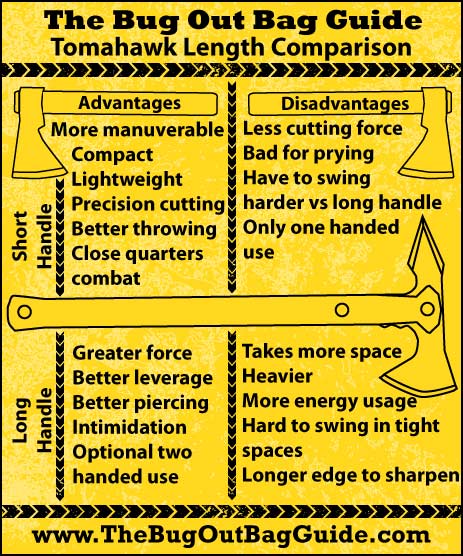
Handle Length

Tomahawks range in length from 8-20 inches.

Determining how long your tomahawk should be will depend on your intended usage.

A longer handle will provide greater leverage when prying and increased force when swinging but will be less compact and heavier.

A smaller handle will enable more effective usage in close quarters and add less volume and weight to a pack.

Here are some applications that are ideally suited for each type of handle:

Long Handle Tomahawk

  • Splitting wood
  • Chopping trees
  • Opening doors
  • Breaking locks
  • Butchering large game
  • Forceful opening of vehicles for rescue
  • Piercing tough materials – kevlar, sheet metal, wood, heavy plastic
  • Prying

Short Handle Tomahawk

  • Long hikes (lightweight and compact)
  • Close quarters self-defense
  • Throwing
  • Precision chopping
  • Evacuating vehicles
  • Butchering small game

Best Tomahawk Length

Back Side

The rear of the tomahawk, also called the poll or butt is traditionally flat or rounded. However, many modern tomahawks offer the option of a spike on the back. Once again choosing what type of poll your tomahawk has will depend on what problems you intend to solve with it.

A bushcraft tomahawk will typically have a flat butt for hammering. If you are looking for the best tactical tomahawk for your kit you are probably going to be seeking a spiked back for effective piercing.

It is worth noting that both a flat but or a spike will effectively break glass. Here are some advantages of each option:

Flat back

  • Hammering
  • Pounding
  • Forcefully opening doors
  • Defeating locks
  • Easier to carry and deploy

Spike

  • Piercing
  • Prying
  • Self-defense
  • Intimidation

Cutting Edge

There are many options for the business end of your survival tomahawk. As with every element choosing the best tomahawk for your kit will depend on your intended usage.

Cutting Edge Length

A longer cutting edge will require a larger and heavier ax head. This added weight and edge length will, however, allow for greater force in your swings. This will make splitting wood and chopping doors easier. Many of the best tactical tomahawks have circular cutouts in their cheeks to save weight without sacrificing the cutting edge size. This may be a good option if you want the largest cutting edge without the added fatigue of a big, heavy tomahawk.

A narrower cutting edge will typically be able to pierce deeper with each strike as it will encounter less resistance. This will make a narrower cutting edge better for emergency vehicle extraction and for piercing heavy duty materials.

Spine and Beard Options

If you are looking for the best tactical tomahawk for your kit it is worth mentioning that modern tomahawks come with additional sharp edges beyond the traditional cutting edge.

This is thought to provide a tactical advantage as it opens up additional options for attack and defense when using a tactical tomahawk. Many modern tomahawk makers have started including these options and it is worth considering when finding the best hawk to meet your needs.

Best Tomahawk

The Best Tomahawk: Take Your Pick

As you can see, there are many factors to consider when choosing the best tomahawk for your kit. As with any survival tool you should consider what you are most likely to use your tomahawk for.

A survival tomahawk is an excellent all around choice for their high versatility and compact designs. If you have more specialized tasks in mind like breaching doors, extracting people from vehicles, or serious self-defense you may want to consider a more specialized tool such as a breaching or tactical tomahawk.

Hopefully, our guide here has helped you understand the many qualities that make a good tomahawk such a valuable addition to a bug out bag or survival kit.

To recap, here are our top picks for best tomahawks by category:

Your Thoughts?

Do you have a survival tomahawk that you love? What qualities do you think the best tactical tomahawk should have? Please let us know in the Comments Section below!

Read More

Bug Out First Aid Kit

Bug Out First Aid Kit Ideas and Checklist

Bug Out First Aid KitA bug out first aid kit is one of the most important essential items to consider for your BOB or evacuation kit.

Having a well-stocked first aid kit will help you overcome injuries to keep you moving to safety when time is critical. As it is prohibitive to carry an entire hospital’s worth of emergency medical supplies it’s important to assess what injuries are most likely to occur and how you can effectively treat them while executing your bug out plan.

We suggest focusing on two areas when building your bug out first aid kit: Trauma and Mobility.

Assessing Your Bug Out First Aid Needs

As we discussed in our Every Day Carry Guide it is important to properly assess the threats you will likely be facing when considering developing a bug out plan or assessing what gear to include in your preparations. When it comes to First Aid, we will look at medium to high probability threats that have medium to high impact to address what we need in our bug out first aid kit.

Trauma Injuries

While it is highly likely that you may scrape your knee or cut your hands while in a bug out situation these minor injuries probably will not affect your ability to effectively move to safety. They are high likelihood/low impact problems. When planning a bug out first aid kit we will want to address medical emergencies that are of higher impact such as trauma injuries. These will be lower probability but far higher consequence than a knee scrape or simple cut and may be debilitating or life-threatening.

Traumatic injuries can include:

  • Burns
  • Vehicle collisions
  • Broken bones
  • Arterial bleeding
  • Falls from heights
  • Gunshot wounds
  • Knife Wounds
  • Blunt impact injuries

Treating trauma injuries should be a focal point of your bug out first aid kit. This will allow you to address the worst of problems and keep you alive and moving when time is critical.

Mobility Injuries

A mobility injury is anything that prevents you from moving efficiently or at your intended pace. They have a wide range in terms of severity. In the risk assessment scale are generally medium probability and high impact. The manner in which one is affected by a mobility injury is that they will lose their ability to move to safety, which is a major problem in a bug out situation.

Mobility injuries include:

  • Blisters
  • Ankle sprains
  • Knee injuries
  • Torn ligaments
  • Frostbitten extremities
  • Broken bones

As you can see there is a wide range of mobility injuries. While some of them may not be life threatening by themselves they can lead an injured person to be unable to evacuate a dangerous area which can lead to further injury or death. Being able to effectively treat mobility injuries with your bug out first aid kit will help you deal with this type of injury and keep you moving when it counts.

Your First Aid Kit: Buy or Build?

When adding a first aid kit to your bug out bag you are faced with two paths of how to get this done. You can either buy a premade first aid kit from a sporting goods store or online or you can purchase the items you want individually for a custom kit. Both choices have their various advantages and disadvantages and ultimately you have to decide what is best for you.

Premade First Aid Kits

Premade kits are the easier choice as they will come prepacked in a neat bag that can simply be added to your BOB. The items are picked for you and this is a plug and play option. However, as with premade bug out bags, premade first aid kits are generally costlier than DIY kits and the quality of medical supplies within them can range greatly.

If you choose to go this route be sure to get a quality kit as you generally get what you pay for and First Aid is not an area to skimp on.

A popular option is to buy a premade First Aid kit and then add a few extra items that don’t usually come with premade First Aid kits, such as a tourniquet or moleskins, which allows you take advantage of someone else doing the grunt work of finding basic items while tailoring the bag to suit your own needs and requirements.

There are good quality premade bug out first aid kits out there and we will recommend a few here for your reference:

Building your own Custom First Aid Kit

Although building your own bug out first aid kit can be time consuming, there are a few advantages to this approach:

  1. Get exactly the items you want – don’t pay for useless things that don’t solve the problems you anticipate
  2. You control the quality of items – no cheap medical supplies that will let you down when you need them
  3. Cost is generally lower – shop around for the best price for the survival first aid items that you need
  4. Get the bag that you want – select a container for your medical supplies based on your own criteria for size, features, and quality

Bug Out Bag First Aid Kit

There are a seemingly endless number of first aid items to choose from out there. Let’s take a look at some of the most important items to have in a first aid kit designed for disaster management.

Trauma First Aid Items

Blood clotting agent

This is a substance designed to encourage clotting within a wound to stop bleeding. They were designed by the military to treat shrapnel and gunshot wounds and have recently been made available for civilian purchase. A blood clotting agent, such as WoundSeal Powder, can be effective for stopping life-threatening blood loss that may occur in a bug out situation.

Burn salve

Burns can come from many threats in a bug out situation. A burn salve, such as J.R. Watkins Medicated First Aid Salve, provides relief from heat-related injuries, discourages infection, and promotes healing. Burn salves are generally small and lightweight, fitting easily in a bug out first aid kit.

Tourniquet

A tourniquet, such as the SWAT-T Tourniquet, is a last line of defense against blood loss. Using one after other first aid methods (pressure, elevation, clotting agents, etc) have been applied will usually stop bleeding but it can do so to a degree that the limb is sacrificed. Additionally, they can only be used on arms and legs and are useless for abdominal or head wounds. The blood clotting agents are a better choice but it can mean the difference between life and death in the right situation to have a tourniquet in your bug out first aid kit.

Heavy Gauze

This is used to apply pressure to wounds, absorb blood, and prevent infection. It is a basic first aid item that belongs in any trauma first aid kit. Plan on packing multiple rolls in a well-stocked bug out first aid kit. Check out Gerber’s Heavyweight Gauze Prefolds.

Skin Closure Kit

Some people recommend a suture kit to close large wounds/cuts but if you don’t have any medical training you will likely cause more harm than good. Instead, pack some 3M Steri Strip Skin Closures for an effective and safe way to close wounds.

Chest Seal

This is designed to create an airtight seal on chest wounds to prevent lung collapse. It is typically used to treat penetrating chest wounds caused by gunshots, stabbing, or shrapnel.  They are sold in pairs to cover the possibility of needing to seal both an entry and exit wound in the torso. The HALO Chest Seal is a highly-praised option.

Trauma Pad

A trauma pad is a large, sterile dressing used to treat large sized wounds. They are frequently impregnated with clotting agents to minimize blood loss. This is ideal for treating trauma injuries in a pre-hospital situation.

Mobility First Aid Items

Moleskin

Taking care of your feet is one of the most important maintenance tasks involved in a bug out situation. If you have to suddenly hike for miles on end to reach your bug out destination, you are likely to develop blisters on the way. Moleskin is designed to provide cushioning around these sore spots to prevent chafing and allow you to keep moving to safety. The good choice for a First Aid kit is Dr. Scholl’s Moleskin Roll.

Triangle Bandages

The Swiss Army knife of first aid kits. Triangle bandages, such as Dynarex Triangle Bandages, can be used for many medical purposes including packing wounds, keep ice packs in place, applying pressure to lacerations, make a sling for an injured limb, and tying on splints.

Splint

Although a splint can be fashioned out of scavenged materials it is good practice to have a good one, like the SAM Splint, in your bug out first aid kit in the event that you do not have time to go looking for splinting materials.

Ace Bandage

These are good for wrapping rolled ankles or twisted knees to provide the support you need to keep moving to safety. They can also be used for wound dressing and bandage application in a pinch. Consider Ace Elastic Bandage with Clips for an easy-to-use ace bandage.

General First Aid Items

Choosing a Bag for Your First Aid Kit

When picking a bag for your bug out first aid kit you will want one that meets your individual needs and has the features you require to be compact, functional, and accessible.

Another important factor to consider is size. Depending on if this is an Individual First Aid Kit (IFAK) or if you are responsible for your whole family, the amount of supplies you need will vary, therefore you need to choose an appropriately sized bag.

The Maxpedition FR-1 Pouch is a compact bag that can carry a deceptively large amount of supplies. You can’t go wrong with this bag.

Closing Thoughts

As you can see there are many options for planning an effective bug out first aid kit. With some simple organization you can either build your own from the ground up, buy a premade medical kit, or combine the two approaches to maximize effort expended and customization options for this essential survival item. Once you have a bug out first aid kit be sure to review it as a part of your periodic BOB Reviews to make sure the items within are still usable.

Do you have an item that you would add to your bug out first aid kit?  Do you have first aid skills or advice that you would like to share?  Let us know in the Comments section below.

Read More

survival pocket knives

Survival Pocket Knives – Our Top 10

survival pocket knives

Survival pocket knives can have many uses in a Bug Out Bag, survival kit, or as every day carry items. They are great tools that combine the nearly limitless utility of a knife with compact size and lower weight. Some people may choose to carry a survival pocket knife as a back up to a larger blade while others may choose to keep one as their main knife. Either way, having one can be a great addition to any kit.  Here we will look at a few survival pocket knives and explain what makes one great for your survival situation.

We will examine features, utility, and size, as well as take a closer look at a few that we chose as Our Picks for best in class.

Our Top 10 Survival Pocket Knives

We have created this helpful comparison chart of the best survival pocket knives out there.  Click on the images below to go to the Amazon page for more information on each of these knives.

KnifeLengthWeightSeatbelt
Cutter
Glass
Breaker
Gut
Hook
Smith & Wesson Border Guard 2 Rescue Knife

10"8.8ozYesYesNo
Gerber E-Z Out Jr Knife

5.5"1.7ozNoNoNo
SOG Specialty Knives & Tools Escape Knife
Survival Pocket Knives
8.2"4.8ozYesYesNo
Wartech 8" Assisted Open Folding Tactical Survival Pocket Knife

8"~8ozYesYesNo
CRKT Graham Folding Razel Knife

~8"6.1ozNoNoNo
CRKT M-21

6.6"4.8ozNoNoNo
GERBER Paraframe II Tanto Knife

9.5"4.3ozNoNoNo
Spyderco Tenacious G

7.76"4.8ozNoNoNo
Buck Knives Folding Omni Hunter Knife

9"4.6ozNoNoYes
CRKT Kommer Free Range Hunter
Folding Lockback

8.9"4.4ozNoNoYes

What Are Qualities of GREAT Survival Pocket Knives?

When I am researching survival pocket knives to add to my kit I search for the following qualities:

Compact and lightweight

I am most likely going to be carrying my survival pocket knife a lot.  It will be an alternative to carrying one of my larger knives and I will want to maximize the advantages present in this type of knife.  There is no point carrying around a pocket knife that is as heavy and takes up as much space as a fixed blade knife.  Because of this I look for folding survival pocket knives that are made of lighter materials such as strong plastics or have a skeleton design to save weight.  I also will want a knife that is 5 inches or less when folded so I can fit in in a pocket or on a belt.

One handed opening

This is a big one for me, I do not want a knife that I may need to use in a hurry in a survival situation that has a NASA-level of complexity for opening it up.

I want to be able to open the blade one handed with either hand.  The knife making industry has recognized the utility of this type of feature and has attempted to answer it in many ways. There is the large thumb hole present in Spyderco knives that many people like but my favorite is the “Carson Flipper” present on CRKT knives, including my EDC choice of the M-21. This is a nub on the back side of the knife that you press with your index finger that lets the blade pivot around the hinge and snap into place with a satisfying click.  It can be done instantly with either hand.  It is so fast in fact that I have a friend that insists on calling it an “assisted opening”, although there are no springs involved.

Be sure you can open your survival pocket knife with either hand when making your choice, you never know what you may need to hold (or hold off) with your other hand when accessing your tool.

Good locking mechanism

The downfall of cheap folders is that they can fail and close on their owner’s hand at the worst possible time.

A good locking mechanism is essential when selecting a survival tool that you are planning on relying on.  Once again, this need has been addressed in many ways by the knife making industry and there are a lot of options out there.  Most of the better survival pocket knives will have multiple, redundant locking mechanisms that will basically turn your folder into a fixed blade knife while engaged.

Save your hands and make sure you have a reliable, fool-proof locking mechanism in your survival pocket knife.

High quality construction

As with any survival tool spending a little more on quality goes a long way on improving your odds.  Name brand knives from quality manufacturers such as CRKT, Gerber, Spyderco, Buck, and SOG will hold their edge longer, be less likely to have their hinge bind, and stand up to dropping and banging better than the cheap pieces of garbage you see on eBay.  Signs of quality to look for are:

  • Components are screwed or bolted on, not glued together
  • Fluid opening and closing motion of the blade
  • Easy to sharpen, holds an edge well
  • Reliable locking mechanism
  • Ergonomic grip that is comfortable and discourages your hand slipping onto the blade
  • Good quality steel or composite metal, check out a comparison of metal types here.

Survival Pocket Knives

Other Features to Consider For Survival Pocket Knives

Finding a good knife with a simple straight blade is a great start and will be a good, reliable tool to have. My EDC knife is just this and has served me well for many years.  However, if you are interested in tailoring your survival pocket knife to your particular survival situation consider these options that are available from many manufacturers:

Survival Pocket Knife Features for Urban Survival

  • Seatbelt/line cutter – This will let you get out of a vehicle faster if you enter a survival scenario during your commute.  This is frequently incorporated by way of a narrow cutout on the back of the knife that is used when the blade is folded in that lets you slide materials in but is too small to accidentally get your hand or fingers in danger.
  • Glass breaker – This will assist your evacuation from a vehicle or building in an urban survival situation.  Easily shatter the glass and go.
  • Pry tip – This is usually a flat tip (instead of a pointed one) on thicker type blades that allows you to jimmy open doors and containers.  It is a tough trade off to make as you will be sacrificing the survival pocket knife’s ability to stab and poke but may be worth it if this is a secondary knife in your kit.

Survival Pocket Knife Features for Wilderness Survival

  • Partial serration – This gives the benefits of both straight edge and serrated knives if you go for a combo blade.  Serration allows for faster cutting of rope, hide, bone, and wood, all things you may be facing in a wilderness survival scenario.
  • Gut hook – This will speed up your ability to dress wild game that you catch.  Many hunting and fishing knives have this feature but if a survival pocket knife is going to be your go-to blade, including this feature will be useful for wilderness survival.

Survival Pocket Knives

Photo credit: – scott feldstein Flickr

Our Picks for Best Survival Pocket Knives

Any of the survival pocket knives listed above would make a great addition to any survival kit as either a primary or backup blade. However, Our Pick for best in class goes to the Smith & Wesson Border Guard 2 Rescue Knife for best urban survival knife and the CRKT Kommer Free Range Hunter Folding Lockback for best wilderness survival knife.  They both combine the essential features that we discussed for their respective survival scenarios with a great basic blade and very high quality.

Conclusion

Although there are a great many survival pocket knives on the market, you can see here that it is not hard to find the best one for your survival situation.  Be sure to consider essential features such as size & weight, ease of opening, quality, reliability, and tailor any special features to your survival scenario.  If you want to learn more about basic survival skills check out our post.  If you are ready to build your Bug Out Bag list, click here to use our free tool.

Your Thoughts?

Have you used any on the survival pocket knives that we examined here?  Are there any features that you look for when researching survival pocket knives?  Please let us know using the Comments Section below, thanks!

Read More

Fish Antibiotics For Humans: A Safe Option For Your Survival Kit?

Fish Antibiotics For Humans

There has been a lot of buzz lately among disaster preparedness blogs and forums about the idea of stocking up on fish antibiotics for humans in the event that there is a disaster or bug out situation and normal medical channels such as doctors, pharmacies, and hospitals are not functioning.

In this guide, we will examine the safety and feasibility of this option as well as look at some other important factors to consider.

Fish Antibiotics For Humans
Are Fish Antibiotics For Humans Safe?

Fish Antibiotics For Humans

The topic of Fish Antibiotics For Humans is a hot issue because some survival perparedness-minded people believe that fish antibiotics are interchangeable with normal doctor prescribed medicines and are a good addition to a survival kit or bug out bag.

Doctor prescribed medications can be hard stock up on so some these individuals are attempting to source an alternative that:

  1. Is effective for curing infections in humans
  2. Is readily available to ordinary people
  3. Is available in larger quantities than the single doses that are normally prescribed

Are fish antibiotics for humans safe?

First off, if you are considering this or any other medical related option, you should perform whatever research you deem necessary AND talk to a doctor. Don’t just take this article as you main resource, the author is not a doctor and does not dispense medical advice.

To answer the question of the safety of fish antibiotics for humans, we must first consider the following factors:

  1. What are the ingredients of Fish Antibiotics vs Human Antibiotics?
  2. What are the dosages offered?

I have researched some common brands of fish antibiotics and created this table to help share the information:

Fish Antibiotic NameActive Ingredient and Dosage
Fin Mox ForteAmoxicillin
500mg
Fin Flex ForteCephalexin
500mg
Fin Flox ForteCiprofloxacin
500mg
Fin Pen FortePenicillin
500mg

So, if someone was interested in acquiring some fish antibiotics for humans, they can see that these readily available medicines appear to be both the same ingredient and in many cases the same dosage as those offered to humans from pharmacies.

Other Factors To Consider When Researching Fish Antibiotics For Humans

1. Does the fish antibiotic have only 1 ingredient – The last thing anyone wants is to buy and take one of these products that also includes a fish health supplement in it that has not been used by humans. Make sure before you buy that the only ingredient in the capsules is the antibiotic that you want such as:

  • Amoxicillin
  • Cephalexin
  • Metronidazole
  • Ciprofloxacin
  • Penicillin
  • Ampicillin

2. Make sure that the dosages are appropriate to what is recommended by a doctor or a well respected resource such as Drugs.com.

3. Store antibiotics properly – These medications should be kept in a cool, dark place with the original seal intact until needed. It is also essential to monitor the expiration date if each bottle and discard and replace any that are out of date.

4. Be aware of allergies – A small segment of the population is allergic to Penicillin and its derivative medicines. Be aware of all medical allergies for anyone you are making a Bug Out Plan for.

5. The rise of antibiotic resistant bacteria in modern society is a major threat to modern medicine. The frequent use of antibiotics in both humans and animals has accelerated this trend. Best practice is to use these drugs only when necessary.

Where Can I Buy Fish Antibiotics For Humans?

Because this is typically administered to fish, there are currently no prescription requirements that this author is aware of (check your local laws).

Without this constraint you will find that fish antibiotics can easily be purchased both from Amazon. Refer to the chart above and click the product name to see it on Amazon.

For further analysis of the topic of fish antibiotics for humans, check out this video by Dr Joseph Alton, author of the excellent book The Doom And Bloom Survival Medicine Handbook and owner of the Doom and Bloom Blog.

Conclusion

It appears that fish antibiotics for humans is a low risk proposition and would be available to be added to a well stocked list of Bug Out Bag Essentials or survival kit. As always, consult with a medical professional before taking ANY medications and conduct your own research before purchasing these products.

Your Thoughts

If you thought this post was helpful, please Like, +1, or Share it using the social media buttons at the top of the page! What do you think of adding fish antibiotics to your Bug Out Bag List? Do you know someone who has taken these products in a medical situation?Please let us know in the Comments Section below, thanks!

Read More

Multi Purpose Survival Tools

Top 10 Multi Purpose Survival Tools for Your Bug Out Bag

Multi Purpose Survival Tools

Here at The Bug Out Bag Guide we strive to build the best survival kit using a philosophy of practicality and efficiency. An excellent way of practicing this mindset is to utilize multi purpose survival gear to meet the needs of our Bug Out Plan. Multi purpose survival gear items improve our survival kit in multiple ways:

  1. Save Space – Why bring 3 items when you can use 1 do do the same jobs? Consolidating items to save space will free up room in your Bug Out Bag to carry other useful survival tools or more food and water.
  2. Save Weight – We have covered at length the perils of weighing yourself down with everything plus the kitchen sink, and have even built a tool for you to check your own Bug Out Bag’s weight. Reducing the number of items you carry will pay increasing dividends the longer you have to travel.
  3. Increase Simplicity / Reduce Clutter – The more items you pack the harder it will be to find what you need. Stick to the essentials – Pack less and improvise more for an efficient survival kit.
Multi Purpose Survival Tools
The Original Multi Purpose Survival Tool

Our Picks for Multi Purpose Survival Tools

We have researched long and hard and compiled a list of the best multi purpose survival tools below. For most categories, there are a great many options of items to consider while building your best survival kit. We have made a recommendation of the best we could find where applicable for those who do not have the time or inclination to search on their own based on utility, size, and weight. However as always, you need to choose the best items for YOUR survival scenario.

Survival Hatchet

These come in many flavors but most of them will do the jobs of a hatchet (obviously), pry tool, shovel, and wrench. We should look for any opportunity to remove high weight to volume ratio items such as steel tools to build the best survival kit, so being able to leave behind any of these is a good step. For more info check out our in depth reviews of the BEST survival tomahawks here.

Survival Whistle

These are generally quite cheap and are cover a lot of the basics. Most survival whistles combine a compass, dry container with the whistle and some even have a fire starting flint within.

Multitool

Anything with both the words “multi” and “tool” in it is worth having a look at. There are a great many options for multitools – focus on weight and practicality when looking. Are you going to really NEED the one with the allen key and corkscrew? Stick to the basics of a straight blade, saw, and can opener (like this one here) and add what few other options you see fit. Some bonus items that are rarely thought about are a magnifying glass and USB stick. These come on some multitools and can be used to start fires and store important family records, respectively. If you want to learn more about choosing the right multitool for survival, you can check out our article here.

Tarp

There is so much you can do with a tarp, it is a multitool all in itself. Besides the obvious of keeping gear dry and being used as a shelter, they can also be used for signaling and be easily turned into a stretcher to carry injured party members.

Plastic Bags

It is good to have a few of these as they have many, many uses and are very light and small. Plastic bags can be used to carry water, keep clothes and fire starting kits dry, store food, and organize small items.

Survival Knife

We covered Survival Knives generally in our Bug Out Bag Essentials post but they are so useful it is worth re-hashing here. Generally you are better off getting a solid, full tang knife from a trusted knifemaker such as Ontario, Camillus, Becker, or Gerber. Stay away from hollow handled survival knives if at all possible. The small amount of storage space will not make up for the overall inferior build quality. For more information on choosing a good knife for any outdoors situation, check out our comprehensive guide by CLICKING HERE.

Duct Tape

Good old duct tape, where would the world be without it? Duct Tape can be used as an emergency bandage, to secure a splint, to reinforce or repair waterproofing, as a rope replacement for shelter building, and taped over sore spots to prevent blisters.

Bandana

A bandana can be moistened and tied around the neck to help keep you cool, be used to filter water, will protect you from the sun, be used as a bandage, be utilized to tie on a splint, or be a replacement for rope in tasks such as shelter building.

Paracord

This is a small, strong cord that can be used in shelter building, ascending or descending inclines, as a clothes line, to fasten a splint, or to build a snare. Read out article about paracord uses and storage here.

Sanitary Pads/Tampons

These are often overlooked but are highly versatile. In addition to its intended use, a sanitary pad can be used as a bandage, it can be shredded and used as tinder, and it can be used to filter sediment from water.

BONUS: Your Brain

I know this is a list of the Top 10 Multi Purpose Survival Tools but this is really worth mentioning. Your own brain is the most valuable multi purpose survival tool that you have. Your mind contains the willpower to persevere in a dire survival scenario, and as importantly, the ability to improvise and modify your Bug Out Plan to overcome unforeseen problems. Rely on your own thinking before any of these other tools we mentioned, it will get you out of most sticky situation.

Top 10 Multi Purpose Survival Tools

We have build the table below to help you consider multi purpose survival tools when planning your bug out bag list. You will see in there Our Picks for the best items that meet our basic survival needs. If you click on the image for any of these, you will open up a window to Amazon.com where you can conduct further research on this item or others like it to see what best meets your needs.

Multi Use ItemOur PickItems it can replaceUses
1Survival HatchetOntario SP16 Spax Tool
Hatchet, Pry bar, ShovelCut, Pry, Break glass, Punch holes, Open/close fire hydrants and gas mains, Open manholes, Self defense
25 in 1 whistleSE - Whistle - 5-in-1
Fierstarter, compass, waterproof container, matches, lighter, signal mirrorSignalling, navigation, firestarting, dry container
3MultitoolLeatherman Sidekick Multi Tool

knife, saw, can openerCut Wood, Clean animals, Harvest plants, Slice rope, Shelter building, Self devense
4Plastic BagsWhatever is in your kitchen pantryDry Bag, Fire starting kit containerBackup water container, Dry bag, Store food, Organize small bits of gear
5Survival KnifeGerber LMF II Infantry Knife

Camp saw, hatchet, can be used for nearly any bushcraft task.Food gathering, First aid, Shelter Building, Navigation, Fire starting, Self defense
6Duct Tape3M Utility Duct Tape
Rope, BandagesEmergency bandage, Repair waterproofing, Shelter building, Prevent blisters
7BandanaHead for Survival Triangular Bandana
Triangle Bandage, HatEmergency Rope, Wet it and tie around your neck to keep cool, Sun Protection, Arm sling, Compression bandage, Filter sediment from water
8ParacordArmy Universe Nylon Military Paracord

Rope, some first aid itemsShelter building, Climbing/descending, grapelling hook, Tie on a splint, Build a snare
9TarpHeavy Duty Tarp
Emergency Shelter, Signal MirrorKeep items dry, Keep you off the ground when sleeping, Made into a stretcher, Used as shelter, Used for signaling
10Sanitary Pads/TamponsWhatever is already in your hygiene kitBandages, TinderFirst Aid for bleeding, Start fires, Emergency water filter, Femenine hygiene

Conclusion

There are many multi purpose survival tools that can be utilized to save space and weight in your Bug Out Bag. Carefully consider the pluses and minuses of each when building your Bug Out Plan and Bug Out Bag Contents List in order to build the best survival kit for YOUR survival scenario.

Your Thoughts

If you thought this post was helpful, please Like, +1, or Share it using the social media buttons at the top of the page! What do you think of these multi purpose survival tools? Is there an additional use for any of them that you know of? Is there any other survival gear that you would recommend? Please let us know in the Comments Section below, thanks!

Read More