upside down fire

How To Build An Upside Down Fire

upside down fire

This past weekend The Bug Out Bag Guide Family hosted a barbecue for some close friends.  One of the highlights of this was testing out an alternative fire building method in our back patio firepit.  Instead of building a standard teepee or log cabin we decided to try building what is called an “upside down fire”.  We got some great, hassle-free results from this that we wanted to share with you.  As I always say, it is always good to add new techniques to your survival skills.  At the end of this article you will know how to build an upside down fire on your own!

Why build an upside down fire?

Over many years of camping I have built hundreds of fires.  These were mostly of the teepee and log cabin variety, with some lean-to fires mixed in as the situation required.  These fire building methods have served me well and I have enjoyed many a meal and evening sitting around their warm glow.

I was excited to learn about a new method of fire building and try it out for myself.  What I learned from my test run, is that there are several advantages that an upside down fire brings to the table.

Upside Down Fire
Here is one I built at home

An upside down fire is self feeding

An upside down fire is built in a layered fashion starting with tinder at the top and increasing in size all the way to large logs at its base.  One of the biggest advantages of using this fire building method is that as a layer burns it progressively ignites the larger layer below it.  The tinder lights the kindling, which ignites the fuel wood, which in turn lights the logs.  In other words, once an upside down fire is lit it will burn by itself for hours.  There is no need to baby sit it and keep adding wood over time!  You can light your upside down fire and then focus on other tasks like setting up camp, preparing food, or just relaxing with your fellow campers.

While traditional fires (teepee and log cabin) do progressively ignite successive layers (if properly built!) they tend to do this over a shorter period of time and require that a fire tender monitors the burn rate and add more fuel and eventually place logs onto the fire.  The genius of an upside down fire is that it frees you from this chore!

Being self feeding makes an upside down fire an excellent choice if you want to keep a heat source burning through a long, cold night.  As it is self feeding you will be able to build it before bed, light it, and then keep warm without having to climb out of your sleeping bag or shelter.

Upside Down Fire
Here is that same fire after 10 minutes

An upsidedown fire generates lots of coals

As an upside down fire burns it creates a large supply of coals from the logs integrated into the base of the design.  These logs are lit as the flame consumes the fuel wood and transfers heat down to this base layer.  These coals are excellent for most cooking purposes.  With a good bed of coal you can:

  • cook foil packets
  • heat up a dutch oven
  • barbecue meat, fish, or vegetables
  • and much, much more…

With a traditional fire you would need to set up your teepee or log cabin and as they got burning need to continually feed it larger and larger logs to get a nice bed of coals going.  The upside down fire does this automatically with the same amount of wood but far less active management.  Set it up, go get your food ready and then come back to a nice bed of cooking coals!

Upside Down Fire
…And again after 40 minutes

Where can I use an upside down fire?

An upside down fire can be used pretty much anywhere you would build a traditional fire.  It can be a great option for many applications:

  • Survival cooking
  • Camping
  • Bonfire
  • Barbecue
  • Wood Stove
  • In home fireplace
  • Rubbish disposal

Can I build an upside down fire in a fireplace?

Yes!  People often build them in fireplaces or woodstoves for the same reasons why they are used outdoors.  Wood stove enthusiasts actually favor the upside down fire building method as it tends to heat up the chimney pipe faster than a traditional fire and by doing so increases the stove’s efficiency.

Upside Down Fire
…And finally, the same fire after an hour burning without my intervention!

How to make an upside down fire

Here is a step by step guide for building your own upside down fire.  Follow the written instructions and refer to the pictures if you run into any trouble.

Step 1: Clear your fire pit

You are going to lay your base layer of logs down in the next step so you will want your pit clear of debris and as level as possible so the fire you build will not topple over as you build it up.

How to build an upside down fire
Clear your fire pit out

Step 2: Lay down the base logs

You are going to build your base layer first.  This means use the largest logs you intend to burn and lay them down parallel to each other.  Have the logs all touching each other so there are no gaps between them and it is best if the tops of them are relatively level with each other so you will have a nice sturdy base to build the rest of your fire upon.

How to build an upside down fire
Lay down your base logs

Step 3: Thicker Fuel Layer

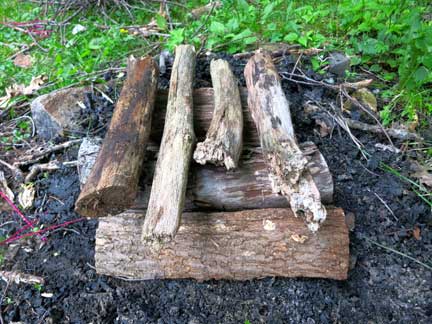
You are going to use large fuel wood for this layer, larger than your thumb.  Remember, this layer has to be large enough to generate enough coals and heat to ignite the logs below it.  Lay this wood in the opposite direction to the logs below it and allow space between each piece for air to flow.  Feel free to build 1-3 layers of this sized wood if you have enough and if you have organized your wood build each layer upwards out of slightly smaller thickness pieces.  Each layer should be laid down crosswise (perpendicular) on top of the layer below, similar to the method used when building a log cabin.
How to build an upside down fire
Add on your fuel wood

Step 4: Smaller Fuel Layer

You are going to repeat the process used in step 3 here but using smaller fuel wood, preferably smaller than your thumb in thickness.  Once again build 1-3 layers of small fuel wood up with each being perpendicular to the last layer and slightly smaller thickness.  You should have a small tower of wood now with the thickness of pieces used getting gradually smaller as you get nearer to the top.

How to build an upside down fire
And now your smaller fuel wood

Step 5: Kindling

Now you are going to start adding on the smaller wood that you have, kindling that is thinner than your pinky.  Add 3-5 layers of this if you have enough to do so.  By the time you get to the top layer the wood should be of the smallest thickness you have, no bigger than a twig.  Stick to the same method of laying each layer down crosswise across the layer below it to allow proper air flow.

How to build an upside down fire
Get your kindling on there next
How to build an upside down fire
And the small twigs on top

Step 6: Tinder

Choosing and adding your tinder is a crucial last step.  You need something that is small enough to be ignited with your match, lighter, or firestarter but that will burn long and hot enough to get your kindling to start burning.  Place this tinder on top of your kindling.  Here are some suggestions for kindling that have worked well for me in the past:

How to build an upside down fire
Finally place your tinder at the very top

Step 7: Light And Enjoy!

Shelter your match and tinder from any wind (If you are lighting your fire with an EverStryke Match, you don’t need to worry about this) and get that fire started.  Depending on what tinder you chose you may need to blow gently to get the tinder going.  As the fire burns each layer that you built should ignite the next one down all the way to your base layer of logs.  In my testing an upside down fire built as I have described should burn for well over an hour and result in a large layer of coals all ready to cook your meal.  Enjoy!

How to build an upside down fire
Your upside down fire is ready to light and enjoy!

Everstryke Banner wide

Your Turn!

So, now you know how you build your own upside down fire.  I encourage you to give it a try next time you are camping or setting up a backyard bonfire.  It is a great tool to add to any fire building arsenal and I think you will be impressed with the results.

Your Thoughts?

Have you built an upside down fire before?  Did you give our step-by-step instructions a try?  Please let us know in the Comments Section below what you thought about this fire building method or if you have any tips or tricks to getting it to work better!  Thanks!

Read More

how to start prepping

How To Start Prepping RIGHT NOW

how to start prepping

This article will show you the basics of how to start prepping and prove that you can take action TODAY to make yourself more self reliant.  Although this article is a great starting point for new readers of The Bug Out Bag Guide it is also a great resource for anyone who is looking for ways to round out their survival skill set or just improve their preparedness.

Who Can Learn How To Start Prepping?

Mainstream media has recently stumbled onto the preparedness culture and has created some TV shows that have warped the public’s perception of our community.  The truth is that the overwhelming majority of people who prep are normal, everyday men and women who look to the modern world and want to make themselves and their families better equipped to deal with uncertainty.

What does this mean exactly?

Being prepared consists of 3 things:

  1. Skills to make your self reliant and able to deal with a wide range of situations
  2. A Plan to deal with likely problems, this should be flexible to deal with unknowable factors
  3. Equipment and gear to help you enact your plan and leverage your skills.  Note that this is last on the list.  You can survive on your skills and plan alone but having the right gear (and knowing how to use it) makes life easier and increases your chances of success.
  • You do not need any special training to learn how to start prepping
  • You can prepare your family without breaking the bank
  • You can learn skills that will improve your preparedness and self reliance at your own pace
  • There is a welcoming community both online and in the real world to support you on your preparedness journey
  • People of all ages can learn how to start prepping!  From seniors to kids, there are skills to learn and contributions to be made.

Prepping Myths Dispelled

  • You do not need to hoard an arsenal of weapons and ammunition to prepare your family.  Some people choose to include weapons training in their prepping, some do not.  It is a personal choice.
  • You do not need to think the world is going to end tomorrow to join the preparedness community, just wanting to be more self reliant is a great reason to get involved.
  • Although individuals are welcome the preparedness community is not dominated by angry loners.  Once you get started you will find a nearly limitless group of motivated people that are excited to share knowledge and resources with anyone willing to learn.
  • You do not need to go out and buy thousands of dollars worth of camping gear to start prepping.  Although survival gear will help you overcome obstacles it is of little help if you don’t have the skills to use it.  Having a bug out bag is a great idea but it is not the end of your prepping.
  • There is no easy way to success.  Preparedness is a mindset and lifestyle that allows you to grow your skills, knowledge, and survival resources over time.  The more you put into getting prepared, the more you will get out of it if you ever need to call upon these skills.

When Should I Learn How To Start Prepping?

Bad news: The best time to start learning or building anything was 10 years ago.

Good News: The second best time to start anything is RIGHT NOW.

Never get discouraged that someone else may be further ahead of you or worry that it is too late.  Right now is an excellent time to start prepping and I am going to give you the tools to do so.  Prepping is something that you can do no matter how much spare time you have.

As I will show you below, you can learn the basics of many survival skills in the amount of time it takes you to read an article or watch a video, typically 10 minutes  or less. While it is true that mastering any skill or completing a larger project such as building a bug out bag will take longer, even these can be broken down into more manageable chunks.  Whenever you feel that you are in over your head remember that prepping is a personal journey that you can walk at your own pace.

Where Should I Start Learning How To Start Prepping?

There are a huge number of places to learn how to start prepping, both online and off.  Here at The Bug Out Bag Guide, we have a wide range of articles and resources to help you get started.

First off, I suggest you sign up to our newsletter. In addition to getting our new articles delivered straight to your inbox, you will get free access to tips and downloadable resources that are ONLY available to our members. Use the form below to sign up to our free exclusive newsletter.

What should I do first? There is so much out there!

Yes, there are a lot of resources out there with information on how to start prepping.  Someone new to the idea may be paralyzed by the number of choices available.  What I suggest is to start simple.  Choose a single, achievable goal and work towards it.  Seeing tangible progress towards becoming better prepared will give you the confidence to tackle tougher tasks down the line.  There are many choices for this initial goal, a good starting point, which can be done for FREE is to learn a basic survival skill.  Sure, it will cost you some time but think of this as an investment.

Your first skill can be anything from how to start a fire to learning how to read a map.  It is best to choose a basic skill such as “how to build a fire” instead of “how to build a fire in a rainstorm on a mountaintop” to keep it achievable in a reasonable amount of time.  The goal here isn’t to turn you into Survivorman, just to learn something practical and inspire you to learn more.

Here are some basic articles that cover these skills to get you started.  Click on the images to start learning:

how to start prepping

How to start prepping

We have a lot of great resources on The Bug Out Bag Guide but in addition to this, YouTube is the great equalizer.  If you have a skill you want to learn that I haven’t already covered there are probably a dozen videos out there showing you how to do it.

How To Start A Fire

How To Use A Compass:


Once you have gained some confidence by learning a few basic survival skills, move up to more challenging task.  You can either improve a skill that you already have (back to “how to build a fire in a rainstorm on a mountaintop”) or try another task such as making a Bug Out Plan or putting together a Bug Out Bag List.

How To Start Prepping

How To Start Prepping

how to start prepping

How To Start Prepping: What’s Next?

You have taken an important first step by trying to figure out what you need to do to improve your preparedness.  However, the most important part of learning how to start prepping is to ACTUALLY TAKE ACTION!!!  It is easy to start something and quit at the first obstacle, people do it every day.

Don’t let your preparedness journey end with reading this article.  Follow the guidelines I have laid out above: start off easy with clear goals and work your way up from there.  I will support you along the way by providing more resources and information to help you grow.  Feel free to email me (Chris) directly using this contact form if you have any specific questions, I am always happy to chat.

Where you go as you learn how to start prepping is entirely up to you!  Prepping is a lifelong learning experience of constant improvement. It offers the very concrete benefit of improving your chances of living through a disaster.  The payoff for your investment of time literally could not be any higher.  Always remember, chance favors the well prepared.

Your Thoughts?

Is there anything else you want to learn about how to start prepping?  What is the first step you would take if you wanted to start your preparedness journey?  Is there anything that is holding you back?  Let us know in the Comments Section below, thanks!

Read More

best rocket stove

How To Build A DIY Rocket Stove

best rocket stove

Rocket Stoves are a great choice for people looking for an off-grid option for cooking, boiling water, and producing heat.  They are a versatile solution for these 3 applications and more.  There are a large range of designs available to build a DIY rocket stove for home or camp.  I recently came across one of the best rocket stove designs that I have seen from Megan at PremiumRocketStoves.com.  It is simple to build, very low cost, requires nearly no maintenance, and performs admirably in the field.  In this article I am going to show you how to use Megan’s design to build your own DIY (Do-It-Yourself) rocket stove.

Megan is a great resource for many preparedness related topics and has made herself into an expert on building the best rocket stove possible from common, low cost materials.  Through PremiumRocketStoves.com she sells professionally made rocket stoves using the design we are sharing with you today.

What is a rocket stove?

A rocket stove is a type of combustion stove that is highly efficient and can burn most any organic material as well as many man made ones.  It incorporates a feeding tube to add fuel (sticks, etc), an air intake, and a chimney to direct the heat that is produced.  Here is a diagram of a rocket stove to help you understand how they work:

Best rocket stove

Part of the versatility of a DIY rocket stove is the variety of fuel materials it can effectively burn.  Here is a list of some of the most commonly used items:

What would I use a  DIY rocket stove for?

Rocket stoves have many applications.  Some people build large scale ones called Rocket Stove Mass Heaters to heat their homes, others use smaller stoves to cook food or as a portable firepit in their back yards.  A rocket stove is also is a great tool for cooking or sterilizing water in a blackout or bug-in situation.  In addition to the many DIY designs, there are a wide range of folding and collapsible rocket stoves used by ultralight backpackers and survivalists.  They are prized for providing a stable and lightweight cooking appliance with a low footprint.  We recently reviewed one of these backpacking rocket stoves made by Emberlit.

Why is a DIY rocket stove better than a traditional fire or wood stove?

There are pros and cons to each of these three methods.  The rocket stove however will burn far cleaner and more efficiently than either of the other two options.  This ability to generate a large amount of heat with less smoke and ash, while using far less wood is why many people choose to build a DIY rocket stove.

best rocket stove

A well designed DIY rocket stove can create the same amount of heat as a wood stove using up to 90% less fuel.  This efficiency advantage is achieved primarily through two parts of the rocket stove’s design:

Insulation

The best rocket stove designs, including the one we are sharing with you today, use a double walled chamber that is insulated against heat loss.  This ensures that all the heat produced is directed up the chimney towards the cooking surface.  A simple fire pit loses a huge amount of heat to the air as it is not insulated at all and flames burned anywhere but directly beneath what you are cooking are simply wasted.

Air Supply

In addition to a fuel feeding tube into the bottom of the combustion chamber a rocket stove will also incorporate an air passage to allow air to flow directly into where the fuel is being burned.  This allows for the fire to pull in as much oxygen as it needs to burn as hot as possible.  As long as this is happening nearly ALL fuel is consumed, which prevents smoke and ash from being generated.  This higher rate of consumption means that more heat is produced with less wood, charcoal, or whatever else you may be burning.

Is it hard to make a DIY rocket stove?

As we will show you here, no it is not hard to make a DIY rocket stove.  Once we had the materials gathered it took us less than 60 minutes to make our own DIY stove!  Also if you don’t have the time or desire to make your own there are lots of places online to buy ready to use rocket stoves, including the fine people at Premium Rocket Stoves.com who provided us with our instructions and raw materials, as well as an assembled stove which we are going to give away to one of you lucky readers!

Here’s how you make your own DIY rocket stove:

We created this video to show you how we made and tested our DIY rocket stove.

Click here if you have trouble viewing this video

If you are the kind of person that likes to read, we also wrote out the instructions below:

What do I need to get started on my DIY rocket stove?

  • #10 Can with lid
  • 2 Large 28 ounce cans for the stove + 1 extra (3 total)
  • Insulation
  • Dremel (tin snips or a chisel can be used instead)
  • Heavy Duty Gloves
  • Marker

Step 1: Cut the outer can

Mark and cut your center hole. With the large #10 can, use a lid from the small can and trace a circle. Then cut it out. Then make sure the smaller can fits into the hole you just made in the #10 can.

Step 2: Make the chimney

Do the same thing but now to the smaller can. Using the piece you just cut out of the #10 can, place it on top of the smaller can and trace then cut.

Step 3: Make the feeding tube

With the can you haven’t touched yet, cut off the rim. Then make about 1.5 inch tabs around the can. Squeeze it through both cans. Fold some of the tabs up to make a snug fit.

Step 4: Cut the lid

With the top lid, trace a circle in the middle of it using one of the smaller cans. Then cut it out.

Step 5: Fill with insulation

First cut tabs around the large can. We cut 8 total. Then pack it with insulation. Fold down 4 tabs, use a hammer. Place the lid with the circle cut into it, on top. Hammer the remaining 4 tabs on top to secure the lid in place.

Step 6: Make a shelf

Cut a rectangle metal piece with flaps that will fit inside. Hammer the metal to make if flat. Cut about an inch slit on each side of the can. Slide the shelf into place then fold down flaps.

Step seven: Fire it up and cook!

Throw some dryer lint in the middle. Place sticks on top of the shelf. Light it and place your pot/pan on top!

 Ready To Build The Best Rocket Stove?

As you can see building your DIY rocket stove is a relatively easy process.  Feel free to refer back to our video up above to see the build and testing process in action.  Well, what are you waiting for?  Get out there and start building!

Your Thoughts?

What do you think about our stove?  Do you have a rocket stove of your own?  What do you use it for?  Let us know in the comments section below, thanks!

Read More

Bug out plan

My First Bug Out Plan Wasn’t Very Good (And How To Make Yours Better!)

First Bug Out Plan

In this article I am going to share the first bug out plan that I made with some family members.  To be honest, it wasn’t great and if you have seen my current article on How To Make A Bug Out Plan you can tell that I have learned a lot since then.  What was once a simple family conversation on how we would meet up and evacuate has turned into a 14 page template that ANYONE can use to create their own Bug Out Plan, which is available for free download here:

First Bug Out Plan

In addition to taking a look at what we came up with to evacuate I am going to show you the good points and bad points of the plan so that you can learn from my experience and go back and improve your own bug out plan.

Lets dive into the circumstances that inspired us to make our first bug out plan and what we came up with.

My First Bug Out Plan: Get Out Of Dodge

I recently shared with you some of the preparedness lessons that I learned during my time living in New York City (article here).  These lessons were as diverse as the events that inspired them and I truly hope that you were able to apply some of the tips I provided to improve your own preparedness.

At the time, there were 5 of us, My Aunt B (mentioned in the previous article as surviving the 9/11 attacks), 2 cousins, my future wife, and myself who worked or lived in NYC.  We were spread all over the city, downtown, midtown, and uptown.  We were fortunate that one of us drove in daily and we agreed that her location was the best meeting point.  Her office at Columbia University was set as the rally point and we agreed to a simple strategy that she would drive us out to our destination of Aunt B’s house.  It was a simple bug out plan, the first that I had been exposed to.  Let’s take a closer look to see good and bad points:

Positives

We took action to make a plan

The fact that we made a plan in the first place is a huge positive.  We had been caught with our pants down in earlier cases, having to scramble and figure things out individually.  Making a plan is the first step towards improving your odds for survival.  If you haven’t read our article on this, take a moment to understand what you can do for yourself here.

We made a specific rally point

My cousin worked at Columbia University, an institution that takes up several city blocks and has many buildings within.  If we had just agreed to meet at the university it could have led to confusion and wasting time to find each other.  Making a highly specific rally point, such as her office in building “X” will save time and reduce potential confusion.

Mode of transportation

Although public transport such as the commuter trains would probably be faster, these have been stopped on more than one occasion due to manmade events, blackouts, hurricanes, and freezing temperatures.  Relying on this could have left us stranded.  So, we chose the most flexible option as our primary go-to.  With a car we would have had to deal with traffic but would still be together and mobile and could always get out and walk.  It is best to choose the most flexible mode of transportation as your primary option.

Destination

We knew where we were going to head to once on the move.  This gave us a goal to keep morale up and also allowed us to tell other family members where they could find us.

First Bug Out Plan

Room For Improvement

We never tested or practiced the plan

Once we agreed to the plan we left it at that, never doing a test run.  If we had to initiate it things may have gone smoothly, thankfully we never had to find out.  However had we carried out a test run we could have found out points of failure and made improvements.

No secondary communication method

If we needed to initiate the plan while we were all in our offices we could call each other on our respective landline phones.  However, if we were in meetings or out to lunch it would be necessary to rely on cell phones.  Anyone who has been in a disaster situation (or even in a huge crowd) can tell you that cell reception can quickly become spotty.  Having a secondary communication method can be a life saving addition to a bug out plan.  This could mean walkie-talkies or having a designated spot where you can leave each other messages or notes.

No backup rally point

While we did a great job of picking a specific rally point, we stopped there.  If for some reason that became inaccessible we would have been lost.  It is best practice to designate at least one secondary rally point away from the primary one.  You never know where it will be safe to meet.  Separate your rally points to ensure your bug out team can get to an alternate if the primary is not available.

No designated secondary destination

Although we were fortunate enough to have multiple extended family member’s homes in the metro NY area to go to if there was a problem reaching our primary destination (Aunt B’s house), we never designated a secondary (or tertiary) location specifically.  This once again could have led to confusion when our other family members were trying to find us.

Stash bug out bags at rally point or workplaces

While I did have a rudimentary BOB at home at this point if a disaster occurred during working hours we all would have been left to survive with just what we had with us.  Storing a get home bag or even BOB at my workplace or at our primary rally point would have made me much better prepared to evacuate at a moment’s notice.

The Aftermath

So, where did I go from here?  Luckily we never needed to execute the plan and I have since moved far from New York City.  I have however continued to grow my preparedness knowledge and planning skills.  As I mentioned at the top of the article I have written an in depth article and created a free template for anyone (including YOU!) to download and fill out to build a Bug Out Plan for their own family, check it out here.  Good luck with your preparedness planning and always remember, chance favors the well prepared.

Your Thoughts?

What did you think of my first bug out plan?  Do you see any other areas I could have improved?  What do you include in your own bug out plan?  Let us know in the Comments Section below, thanks!

Read More

Urban Prepping

10 Preparedness Tips From Living In NYC

bug out bag

There are many places we can look to learn the skills and knowledge we need to help ourselves and our loved ones survive.  Often times one of the best teachers is the world around us.  I experienced this over the 7 years that I lived in New York City.  Living there provided many practical and at times terrifying lessons in urban survival and disaster planning that I hold on to today.  This was caused by the pervasive impact of the 2001 attacks as well as multiple events that occurred while I was living there afterwards.  In this article I am going to share with you some of the life changing events that I experienced and show how to apply the lessons learned to your own preparedness journey.

In the beginning…

Growing up in the suburbs, New York City (or simply “The City” as we called it) was an entrancing place that children were taken to on field trips and whispered about by older siblings who managed to sneak down for a concert or night out.  It held great mystery and allure, there always seemed to be so much going on there.  It was common that a fair percentage of kids from my home town would end up there after (or instead of) college to pursue opportunities and adventure.  I myself took this path at the ripe age of 22, moving with a girlfriend (now wife) into a shoebox of an apartment as we both landed jobs in the financial sector.  I lived there for 7 years, from 2003-2010 and although I have since moved on a large part of me remains there and I loved the overwhelming majority of the experience.

The day of days

Anyone who is old enough to read these words will remember where they were on September 11, 2001.  I was as far away from the epicenter as I could have been, just 3 days into a 3 month exchange program in Australia.  I remember walking into the lounge room after a night out and seeing everyone glued to the TV.  It was early in the event and the newscasters were still calling it an accidental plane crash.  Then the other plane hit.  It flashed in my mind that I had an Aunt working in the WTC.  The distance from home could not have seemed greater as I ran to the phone and frantically dialed home.  My mother was in a panic and had not heard from her sister.  We spoke briefly as to not tie up the phone line.  We reassured each other that we were both OK and she promised to call as soon as she heard more news.  Hours later I got a phone call that my Aunt B had safely been evacuated from Tower 7, which later collapsed.  One small bright spot in an unspeakable day.  Growing up in the area I know many families that were not so fortunate.

prepping tips
The sunset from my NYC apartment

Lessons From Modern Day NYC

It has been over a decade since that terrible day and New Yorkers have done what they can to grow past the events of 2001.  Not moved on, but perhaps grown scar tissue over the wound.  People go about their lives without living in fear and accept changes such as seeing more police and national guardsman in public locations.  Perhaps more subtle are the new physical changes that have cropped up.  For an example, we can look at the iconic skyscrapers that give New York City its distinctive skyline.  Most skyscraper office buildings have a large glass atrium on the ground floor.  This will nowadays be invariably surrounded by a picket line of heavy concrete barriers to prevent a truck ramming in with bad news in the payload.  Great pains have been taken to disguise measures such as this by planting trees or flowers in the barricades and most people would walk by them without even noticing.  This is the epitome of modern day NYC.  Be safe but keep living your life.

Lessons Learned:

  1. Learn from and grow from any negative experience after grieving is over
  2. When possible make your preparing a part of every day life to make it less overbearing
  3. Live your life to the fullest

A Deadly False Alarm

At one point during my tenure in NYC I was working in midtown Manhattan right around the corner from Grand Central Terminal.  This train station is one of the busiest commuter and subway stations in the world and its beautiful architecture and design make it a popular tourist destination (Personal note: if you ever visit NYC, stop by Grand Central.  It is one of my favorite places there).  All these things also made it a widely acknowledged soft target for terrorism.

One warm summer evening in July 2007 I was leaving work and in the elevator with several colleagues.  We experienced a shudder and a brief power outage.  When the lights came back on seconds later the elevator had stopped.  To break the tension, I made a remark “Well, I have lived a good life”.  Nervous laughter escaped and the elevator started moving again, taking us to the ground floor.

What we were met with was chaos.  We could see people out in the street literally screaming and running northwards past the front of the building.  I have burned into my memory a woman in a business suit and high heels running past me with tears streaming down her face saying over and over, “Not again.  Not again.”

We had no idea what was going in. We looked out the front door to see what they were running from and saw a large black cloud erupting front the middle of the street about 2 blocks away.  We joined the crowd moving northwards, calling our loved ones around Manhattan telling them we had just seen an explosion and they needed to move NOW.  This actually took convincing as more than one person said, “No one here is freaking out and we haven’t heard anything about it on the news”.

When I eventually arrived home I flipped on the TV and began to pack supplies.  After a few minutes I learned that the explosion had been caused by an underground steam pipe from 1924 that had burst.  Although it had not been ruled out, terrorism was seen as unlikely.  It ended up a couple people did die and many were injured regardless of the cause (see here for more info on the event).

That was it, a steam pipe bursting and it had sent everyone in the area into a panicked frenzy.  Part of this was lack of information and the location (right next to Grand Central).  But the other part was the scars of 9/11 that people still bore.

Lessons Learned:

  1. Although it was a steam explosion, the next time it may be an intentional event.  I did the right thing by trusting my instincts to move away immediately.
  2. Reaching loved ones was difficult as the cell phone services were immediately jammed with EVERYONE trying to do the same thing – Have alternate means of communication.
  3. Once they were reached they required a conversation to get them going – Have a code word to cut through this.  Discuss this with whoever you need to and gain an understanding of when I call/email/text XXX it means GO!
  4. When I got home I wasted time packing a bug out bag – Have one ready at all times.  Or, if I had a get home bag ready at my office I could have gone back up and grabbed that.

urban prepping

A Threat From Afar

One beautiful August Sunday afternoon in 2004 I was barbecuing at a friend’s place, relaxing and generally having a great day.  We were watching the game and it was interrupted by a news flash.

It was reported that a laptop had been found in Pakistan that included detailed plans to attack several financial institutions in our fair city. One of the buildings specifically listed was the Citigroup Center.  I had been working for Citigroup for a couple of years at this point and frequently worked out of this exact building.

I was frozen in my tracks.  Why would someone that I had never met want to kill me because I worked in a particular building?  To this day it makes no sense to me.

The response from the national, state, and local government was overwhelming.  Laura Bush actually came to the Citigroup Center to have lunch to show support.

I showed up to my office building on Monday not knowing what to expect.  I knew some people were planning on not showing up to the office until more information came out.  When I arrived what I was met with was, as I said, overwhelming:

  • A line of police cruisers literally around the block
  • Armed National Guardsmen on the corners
  • Bomb sniffing dogs circling the building
  • Newly installed airport style metal detectors and x-ray machines that had to be passed through to get in the front door

The show of force helped inspire confidence in my fellow employees.  People could come to work knowing that others were working around the clock to keep them as safe a possible.  I never really got used to having to get my bag x-rayed and emptying my pockets before getting to my desk but it did help others reduce the spectre of violence from their everyday lives.  Once this was overcome people were compelled to outwardly show resolve and return normalcy to their everyday lives.

Lessons Learned

  1. Violence really can come from any place any where.  There is not much to do about this really other than prepare as best you can, keep your eyes peeled and most importantly keep on living your life.
  2. The people that would carry out these terrible acts against us cannot be reasoned with.  Or, if they can, their frame of reference is so alien to my own that constructive dialogue is impossible.
  3. We cannot live in fear.  Do everything you can to return a sense of normalcy to yourself and those around you.  Lead by example if you can.  Love or hate the Bush Presidency, I respect Laura’s attempt to show strength through her own example.

How Did I Take Action?

These events were a big a wake up call to me and my family members who either lived or worked in NYC.  We ended up putting together my first rudimentary bug out plan to be ready for whatever may come next.  To be honest, it wasn’t a very good plan but basic enough to work.  Thankfully we never needed it.  I will be going over this first bug out plan in another article in the near future, so keep an eye out for it for it!   I will highlight good points and areas for improvement in this original plan as well as show you how you can use my mistakes improve your own plan.

urban survival
A beautiful Autumn day in Central Park, life carries on

What to take away from it all?

There are some serious points and dark times discussed here.  However, I think it is important to say that in the 7 years that I lived in NYC, these never overwhelmed the amazing experiences and fantastic people that I met along the way.

This is what I think should be the big takeaway.  Although we are all a little more wary than we used to be and some things have changed we can NEVER allow this to run our lives.

By all means prepare yourself as best as possible and learn what skills you can to help you survive and protect your loved ones.  As I continue my own life’s journey I will certainly continue to do so.  But, I will also live, love, and learn a far greater amount of the time.  No matter what happens I will focus on the positives in my life such as my family and the friends I have made and adventures we have had rather than the dark moments.

Your Thoughts?

Have you had an experience that has taught you an important preparedness lesson?  Please share it with us in the Comments Section below, thanks!

Read More